Signed Appliance Releases and Photon Updates
Appliance Update is audited runtime maintenance, separate from desired-state enforcement and
/ui/management/appliance-apply. The web
process queues work, and atlaso-worker.service executes it as a durable appliance-update task. Each manual or
scheduled check/install is one parent task with an ordered child step for every selected stream. The child owns its
status, progress, timestamps, compatibility evidence, error, and bounded redacted helper output. The parent retains the
shared source snapshot and aggregates the selected channel and release, verified key ID, checksums, service checks,
rollback result, and final outcome.
Interface overview
This verified appliance view provides visual orientation before you begin.
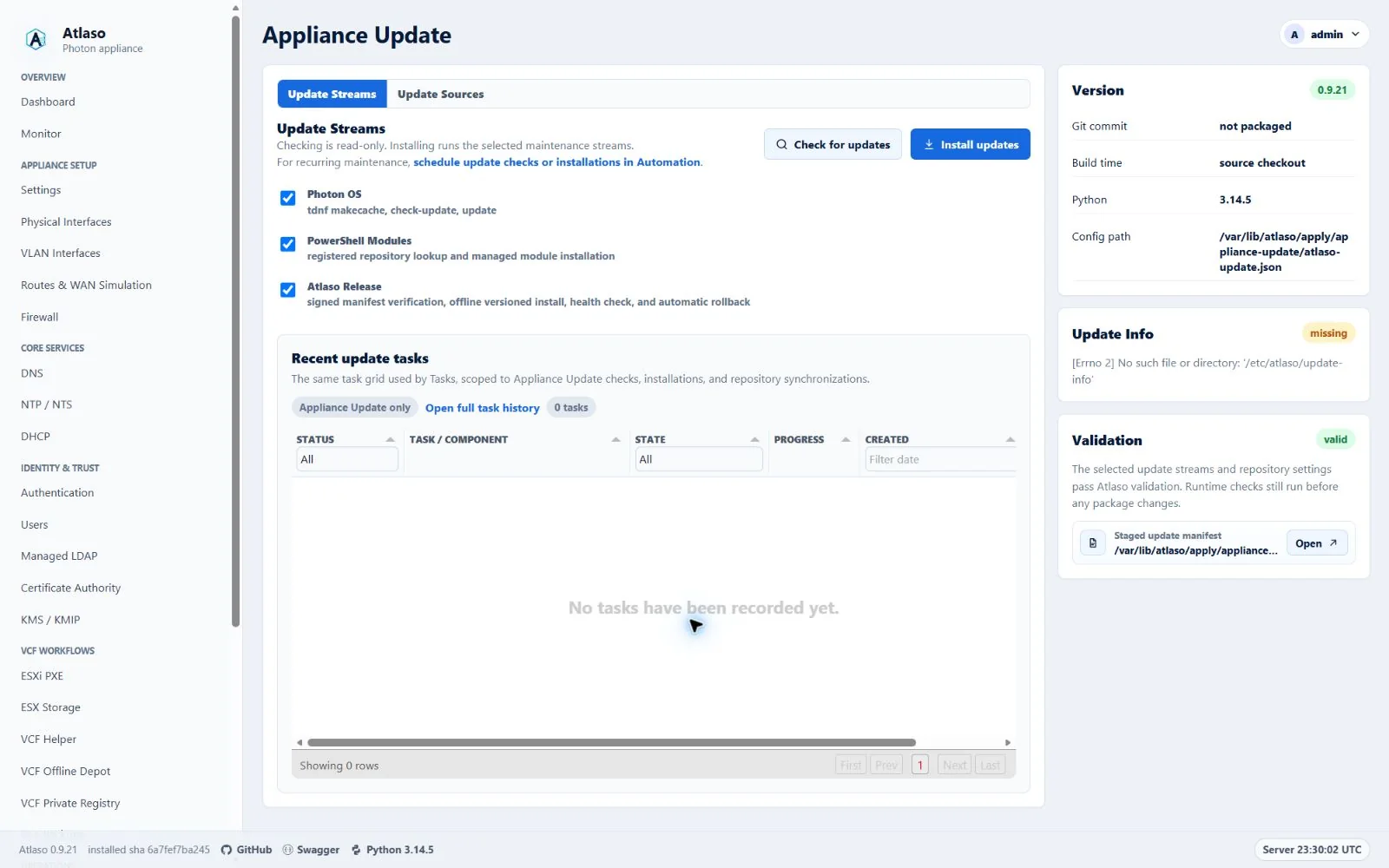
Figure: Appliance Update in the verified clean-appliance desktop state.
The worker requires successful data-disk preparation but only orders after and wants the Atlaso web service. A release transaction can therefore stop and restart the web service without systemd propagating that stop to the worker that owns the update task.
Update streams
Atlaso has three update streams:
- Atlaso Release installs one signed, self-contained application release. It replaces the former independent Atlaso wheel and Python Libraries streams.
- Photon OS checks or installs packages only after validating the proposed system Python ABI against the active Atlaso release.
- PowerShell Modules checks or installs the explicitly managed modules from their selected repositories. After
installing or updating
VCF.PowerCLI, the helper reapplies and verifies the centralized VMware CEIP preference at PowerCLIAllUsersscope. ExplicitUserandSessionoverrides remain outside Atlaso ownership. Privileged PowerShell work uses the root-owned home/var/lib/atlaso/powershell, so synchronized repository state persists without depending on the service's read-only/rootview.
The appliance never performs a broad runtime pip --upgrade and never contacts PyPI during a Atlaso release update.
Application dependencies and bootstrap tools are exact, hash-locked wheels inside the release bundle.
Checks execute every selected child even when another check fails, which keeps diagnostics independent. Installations preserve the safety order Atlaso Release, PowerShell Modules, then Photon OS. PowerShell remains independently observable after a release failure, while Photon is marked skipped with an explicit reason if either earlier selected stream failed. The parent succeeds only when every selected child succeeds.
Release sources and channels
GitHub is the default distribution origin:
- GitHub Releases stores immutable versioned manifests, signatures, and bundles.
- GitHub Pages publishes signed
development,preview, andstablechannel pointers. Its root serves a small informational release-repository page; appliances continue to use only the signed JSON documents under/updates. - A successful
mainCI run publishes the exact successful commit asvX.Y.Zand advancesdevelopment. - A protected manual dispatch may recover a failed publication only by naming a full commit that already has a
successful
mainpush CI run. The workflow verifies that provenance and that the commit remains onmainbefore rebuilding and signing its deterministic release inputs. - The manual promotion workflow advances
previeworstableto an existing verified release. Promotion never rebuilds the artifact. - The shipped default is
stable. Every Pages writer refuses to publish a tree where its manifest or detached signature is absent. Release and promotion workflows also re-fetch the live channel pointer and immutable release manifest, verify both signatures with the named appliance trust key, require matching version and commit identity, and confirm CPython 3.14 compatibility before reporting success. The live verification retries through a bounded ten-minute Pages deployment and CDN propagation window. A monotonic deadline caps both request timeouts and retry delays to that wall-clock budget so a stalled endpoint cannot retain the shared Pages publication lock indefinitely.
The default source is:
The human-facing Pages URL is https://mdaneri.github.io/Atlaso/. The repository name is case-sensitive in the
project-site path. The landing page contains no updater state or trust material and does not replace signature
verification.
For the stable channel, the appliance reads:
https://mdaneri.github.io/Atlaso/updates/channels/stable/manifest.json
https://mdaneri.github.io/Atlaso/updates/channels/stable/manifest.json.sig
Operators may add HTTPS mirrors and failover sources. A mirror copies the original channel pointers, release manifests, signatures, and bundles without re-signing them. Every source must satisfy the same signed v2 contract. Credentials remain encrypted in the database and move to the privileged helper only in the existing mode-0600 transient file. They are not written to manifests, tasks, audits, URLs, or helper output.
Create a Photon, PowerShell, or Atlaso source from the + Repository launcher in that ecosystem's repository tab strip. The guided workflow collects repository identity, its endpoint and ecosystem-specific trust policy, desired availability, and a final review. Configured source tabs remain read-only. Select Edit repository beside Delete repository from the icon actions at the right of Repository identity to reopen the same wizard with the source's current values. Creating or editing through the wizard saves desired state only: it does not install packages or change a running package client.
The compact synchronization icon exposes Synchronize repositories on hover and to assistive technology. It explicitly writes only Atlaso-owned tdnf and PowerShell client configuration through an audited Appliance Update repository sync task. Starting synchronization keeps the Update Sources workspace in place and refreshes only the shared Recent update tasks grid while the task runs. Saved, not synchronized means the desired repository is stored in Atlaso but has not yet been validated or written into its appliance package client. Atlaso records synchronization results per repository. A managed Photon repository must have a successful result before Photon OS checks or installation can use it, including immediately after the repository is created or edited. When one repository fails, other repositories that synchronized successfully remain ready. Atlaso disables the check and install actions only while a selected stream still depends on an unsynchronized repository. Selecting an older task for detail never changes current readiness; only completion of the synchronization task just submitted from the page updates the actions in place. Streams that do not depend on the failed package synchronization remain available independently. Source details also show when synchronization succeeded or failed. Signed Atlaso sources are read directly, are checked during each update, and do not configure pip or report package-client synchronization state.
Synchronization resolves each enabled PowerShell repository host before invoking PowerShellGet. A DNS failure names the repository and unresolved host directly in the task error instead of presenting PowerShellGet's generic invalid-URI message or only an aggregate step failure. It also performs a repository lookup after registration, so a reachable host with an invalid API path fails synchronization. PowerShell module checks and installations require every referenced repository to have a successful synchronization result; saved edits cannot silently reuse stale package-client state.
Each source detail presents repository identity first, then its location or discovered runtime data, followed by read-only Repository behavior values. Desired-state guidance and synchronization state remain together in a separated footer. The accessible edit and delete icon actions stay together in the identity header. After a successful create or edit, Atlaso reloads the server-rendered source details while preserving the Update Sources workspace and selected repository tab, so the read-only values immediately match the saved desired state.
The peer POWERSHELL · managed modules disclosure uses the same section spacing, count badge, read-only detail hierarchy, and tab treatment as the repository disclosures. Each module tab presents identity, repository, version policy, target version, and desired state without implying inline editing. Edit module and Delete module remain together in the identity header. Both + Module and Edit module open the shared reviewed wizard for module identity, version resolution, enablement, and final confirmation; saving it does not install the module. Server-side validation failures remain in the open wizard with the attempted values intact so an administrator can correct the entry without rebuilding it. Successful module saves use the same preserved-workspace reload so the read-only module detail immediately reflects the new policy and state.
A single shared Tasks grid remains below both Appliance Update tab panels, so recent work stays visible from Update Streams and Update Sources. It is server-scoped to Appliance Update tasks and preserves standard sorting, filtering, progress, row menu, and detail behavior. Because the embedded endpoint is already scoped to Appliance Update, the Task / Component column is fixed there; the full Tasks page retains its editable component filter. The grid expands through the remaining workspace height rather than using a compact fixed-height embed. This table replaces the former Last Update rail and submission-result cards. Checks and installations submit asynchronously: only grid data refreshes, the new task is highlighted, expanded stream rows stay expanded, and both action buttons remain disabled until that task succeeds, fails, or is cancelled. Parent rows identify Appliance Update check, Appliance Update install, or Appliance Update repository sync so read-only checks are distinct from package-changing work. The stream actions use explicit Check for updates and Install updates labels, with distinct search and install cues and visible copy that identifies the check as read-only. The same header links recurring maintenance to the Automation Schedules workspace, where operators can schedule Appliance Update checks or installations. The Update Info rail card reports whether durable updater evidence is available and opens the full JSON through the shared preview modal, matching Validation instead of rendering unbounded output inline.
Trust contract
Appliances contain named Ed25519 public keys under:
Private signing keys exist only in the protected appliance-release GitHub environment. The updater rejects missing,
malformed, unknown-key, mismatched, or invalid signatures. A release may add a future public key because its contents
are already signed by a currently trusted key. Old keys are retained until an overlapping signed release has provisioned
the replacement.
Photon image builds stage the checked-in image/common/update-trust directory and fail if it is missing, empty, or
contains a malformed public key. The development-only VMware deploy-wheel.ps1 bridge also synchronizes every
checked-in .pem public key into the root-owned trust directory. Updating only the application wheel cannot repair a
missing trust store because the unprivileged application does not write /etc.
If an appliance reports that a named channel signing key is not trusted, first verify that the matching checked-in public key exists on the appliance:
sudo ls -l /etc/atlaso/update-trust.d/
sudo openssl pkey -pubin \
  -in /etc/atlaso/update-trust.d/<key-id>.pem \
  -noout
Rebuild or redeploy an affected development appliance with the corrected image or deploy-wheel.ps1. Production
operators must provision the exact published public key through a trusted out-of-band appliance maintenance path; never
disable signature verification or copy private signing material to an appliance.
A signed channel pointer contains its channel, selected version and full commit, immutable release-manifest URL, issue time, and signing-key ID. The signed release manifest contains its version and commit, build time, updater protocol, database schema version, supported Python ABIs, bundle URL/size/hash, and a hash for every bundled file.
Atlaso accepts only signed v2 channel pointers and immutable release manifests. The Pages root is informational and is not part of the update trust contract.
Transactional installation
The helper verifies the channel and release signatures, URL contract, updater protocol, current Python ABI, bundle size/hash, safe archive paths, exact content set, and per-file hashes before it can switch the running release.
Each candidate is built under:
The helper creates the candidate virtualenv from the ABI-specific retained wheelhouse with PIP_CONFIG_FILE=/dev/null,
--no-index, --require-hashes, and no network dependency resolution. It then runs pip check, imports the
web/worker/console modules, and validates the installed entry points. /opt/atlaso/current points at the active
release, while /opt/atlaso/.venv points through current to its virtual environment.
Before switching, the helper enables the nginx maintenance response, pauses the web and console services, closes the
worker's database session, and creates a consistent SQLite backup. It installs the matching privileged helper, systemd
definitions, nginx data-disk dependency, stable disk-identity rule, and platform-specific data-disk policy. The
transaction reloads the identity rule and runs the release-owned data-disk preflight before it atomically changes
current, starts the application, and probes internal /openapi.json. Unknown or contradictory platform evidence,
an unsafe disk, or a missing release-owned safety asset fails the update and restores the prior files. When upgrading
from an updater that predates these safety assets, the candidate helper is still installed through the updater's
existing helper path. The candidate atlaso.service then runs that helper as a root pre-start gate to install the
complete signed safety set, migrate exact claims for already applied ESX Storage disks, reload disk identities, and pass
the release-owned disk preflight before the control plane can start. The bootstrap backs up its safety assets, claim
allowlist, and database first; a migration or preflight failure restores all three plus the prior systemd and udev
state. After that bootstrap succeeds, its permanent systemd dependency remains fail-closed if a later candidate health
check rolls the application back; the previous control plane can restart only after the same disk preflight succeeds.
Fresh images mark their minimal bootstrap-<version> release explicitly and skip this candidate-only compatibility
step because image provisioning has already installed and validated the safety assets directly from the staged source.
Both paths write a root-owned completion marker, so ordinary control-plane restarts bypass the compatibility transaction;
the permanent atlaso-data-disks.service requirement continues to enforce disk readiness on every start.
When upgrading an older release, the transaction first derives exact root-owned claims for already applied, boot-safe
ESX Storage volumes from the database and live block inventory and migrates persisted stable-device aliases for both operator-mounted
and Atlaso-formatted volumes to the selected live identity. The database identity and boot claim
participate in the same rollback boundary; an ambiguous, unsafe, or concurrently changed configured volume fails closed.
Any failure restores the previous release link, helper, service, current-updater-owned disk-safety files, and database
snapshot before maintenance mode is removed. The first legacy-updater transition restores its private bootstrap
transaction on migration or preflight failure and retains the validated safety boundary only after that transaction
succeeds, as described above. A root-owned finalizer at
/var/lib/atlaso/apply/appliance-update/finalizer-status.json records the definitive transaction result so the worker
can persist the durable task outcome. Without a matching definitive finalizer, worker startup marks an interrupted
running parent failed even when every child step committed before the restart; child results remain available as
recovery evidence. Only the current and previous known-good releases are retained; the UI does not expose arbitrary
historical downgrades.
Photon OS boundary
Manual and scheduled Photon checks/installations remain available. Before mutation, the helper records an inspection of
the proposed tdnf transaction and queries all repository candidates with the Photon-supported tdnf repoquery python3
interface, then deterministically selects the highest advertised minor ABI. It fails closed if that ABI is not listed in
the active signed Atlaso bundle.
If Photon changes Python to another supported ABI, the helper reconstructs the active virtualenv from the retained offline wheelhouse before restarting and probing Atlaso. It does not claim automatic RPM rollback and never reboots automatically. If OS maintenance leaves the appliance unhealthy, the task records the transaction evidence and manual recovery boundary.
Atlaso 0.9.18 is a clean-break appliance release. It does not migrate databases, schedules, credentials, update sources, or installed environments from the retired product. Deploy a fresh Atlaso appliance and configure its signed update sources directly.
Signed lifecycle fixture
Hyper-V lifecycle coverage can exercise the complete release transaction with:
scripts/windows/hyperv/invoke-lifecycle-test.ps1 `
  -SignedReleaseRepositoryUrl https://release-fixture.example.test/updates
The fixture must use the appliance's named test trust key. Its signed preview channel must select a healthy release
newer than the image baseline; its signed development channel must select a candidate that reaches database startup
and then fails the service-health probe. The lifecycle runner proves that each release task exposes a Atlaso Release
child step, proves the preview upgrade, expects the development parent and child to fail with rolled_back=true, and
compares the active release, compatibility virtualenv, database schema hash, and user identities before and after
rollback. It then rechecks the web, worker, console, internal /openapi.json, and host-facing API. Omitting the URL
skips only this externally supplied fixture.
Release operator workflow
The protected workflows use these checked-in inputs:
requirements-appliance.lock
requirements-appliance-bootstrap.in
requirements-appliance-bootstrap.lock
requirements-release-tools.in
requirements-release-tools.lock
image/common/update-trust/
These dependency inputs and hash locks are committed public release inputs: they contain package metadata and integrity
hashes, never credentials or private package-index configuration. The CI declaration fingerprint prevents dependency or
Python-range changes without a regenerated hash lock. Release CI installs only the hash-locked bootstrap tools, verifies
every downloaded wheel or source archive against the checked-in lock, builds any missing pure wheel without build
isolation, and writes an ABI-specific requirements-wheelhouse.lock over the resulting wheel bytes. It does this for
the appliance's CPython 3.14 runtime before running:
python scripts/build_release_bundle.py \
  --wheelhouses wheelhouses \
  --signing-key /protected/release-key.pem \
  --signing-key-id atlaso-release-2026-01 \
  --commit <successful-main-sha>
Publication is idempotent. An existing tag or release must identify the same commit and exact asset bytes or the workflow fails. Annotated release tags use an explicit GitHub Actions bot identity and do not depend on runner-global Git configuration. Each GitHub Release description keeps the exact signed source commit first, then appends GitHub's generated changelog. The checked-in release-note configuration groups merged pull requests as new and improved work, fixes, documentation, dependency updates, or other changes; dependency updates are excluded from the enhancement group so they appear only once.
To preview generated notes for the current signed-release lineage without changing GitHub, authenticate gh for the
repository and run:
Review every rendered body before adding --apply. The command resolves each release's annotated tag to its exact
commit, uses the immediately preceding published semantic-version release as its comparison point, and preflights the
entire range before the first edit. Historical tags predate the checked-in release-note configuration, so the command
requests GitHub's default merged-pull-request, contributor, and comparison content, then groups those pull requests from
their current labels using the same Atlaso category precedence. It updates only a legacy provenance-only body, skips
notes that already match, and refuses unexpected or manually customized text. Immediately before each edit it
revalidates that the body and release identity still match the preflight snapshot. After every edit it verifies that the
title, tag, target, publication state, and asset identity remain unchanged. Body verification accepts GitHub CLI
normalization between LF and CRLF line endings but no other text difference:
Atlaso starts a new signed update lineage at v0.9.18; it does not consume or publish the retired product's update
bridge. If an otherwise successful main release fails after signing but before publication, run Publish appliance
release, provide the exact successful main commit in release_sha, and verify the recovered tag, release assets,
signatures, and development pointer. The dispatch refuses commits without a successful main push CI run and
preserves the normal tag/release mismatch checks. If the tag and release already published but channel advancement
failed, dispatch the same successful SHA again: publication verifies the existing asset names and bytes before retrying
the signed pointer update.
To initialize or advance the default channel, run Promote appliance release, choose stable, and provide an
existing verified version without the v prefix. The workflow does not rebuild that release. It completes only after
the hosted stable pointer and signature resolve and the referenced immutable release passes signature, identity, and
CPython 3.14 compatibility validation. Use the same workflow with preview for pre-stable promotion.
Schedules for checks or installs live under Operations → Automation. See automation.md.
Additional verified states
These captures show responsive layouts and useful operational states referenced by this page.
Appliance Update
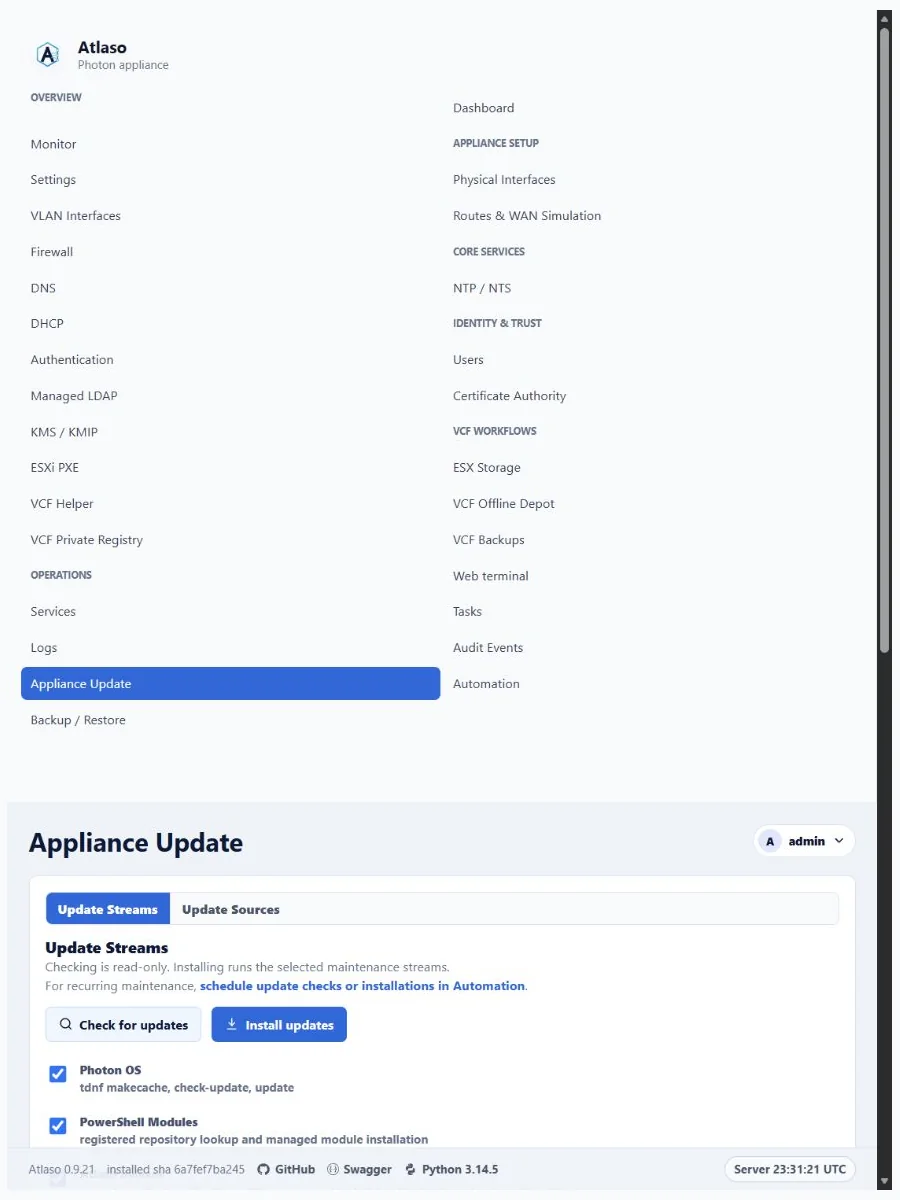
Figure: Appliance Update in the verified clean-appliance responsive state.