Firewall
Open Firewall to manage Atlaso-owned nftables desired state. The page combines generated service-listener rules, routing permissions, and operator-defined access groups.
Interface overview
This verified appliance view provides visual orientation before you begin.
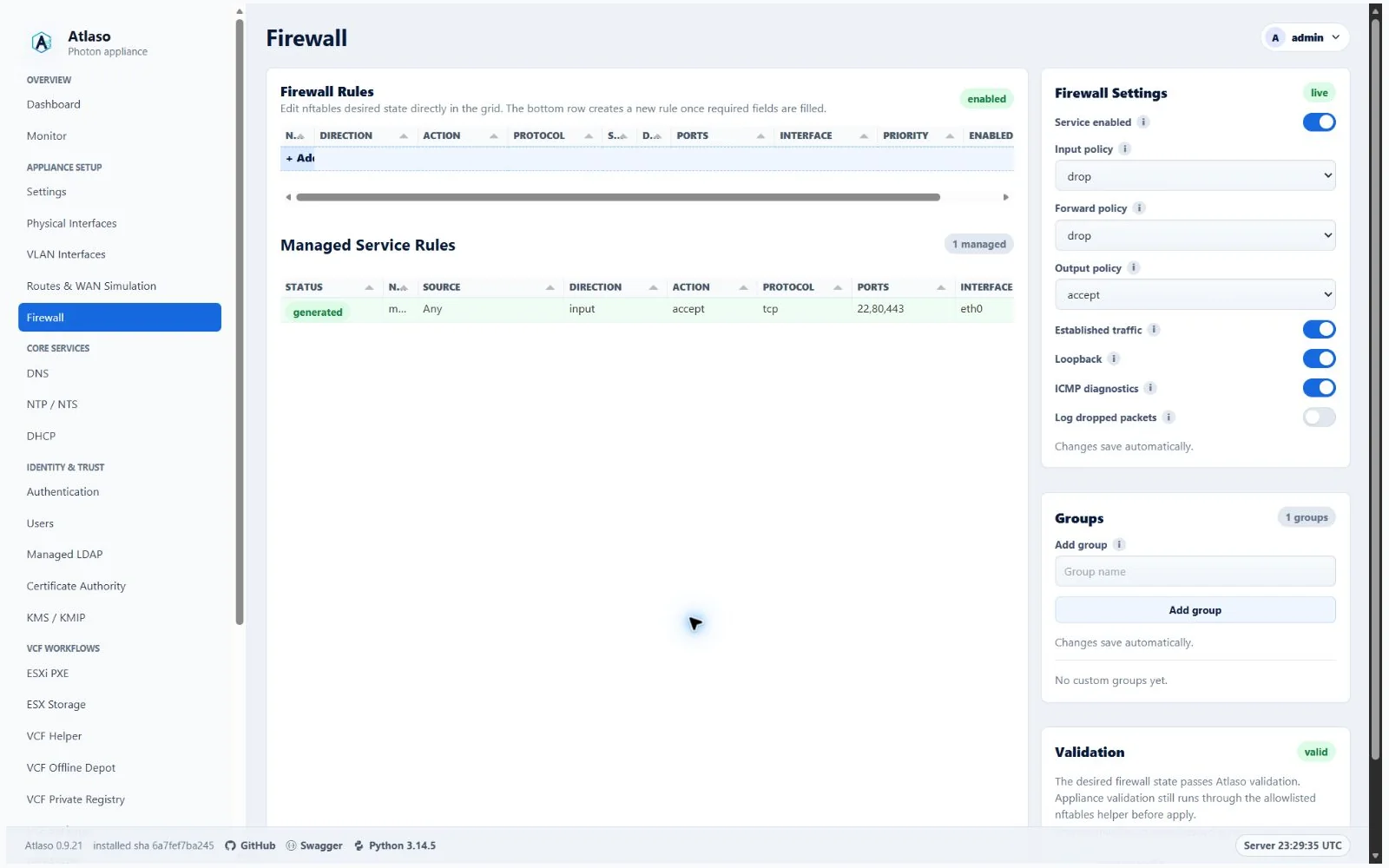
Figure: Firewall in the verified clean-appliance desktop state.
Select Add rule here or open an existing operator rule to use the five-step guided workflow. Rule identity, traffic matching, priority and notes, enablement, and final review are separate decisions. The dedicated Enablement step makes clear that enabling a rule changes rendered desired state only; enforcement still waits for the global Firewall appliance-apply unit.
Review safely
- Confirm management access remains allowed from the intended source.
- Review enabled service listeners and their bound interfaces.
- Use access groups to narrow sources or destinations when
Anyis too broad. - Inspect the rendered ruleset and resolve validation errors.
- Submit the Firewall unit through Appliance Apply.
Atlaso always blocks management-to-lab and lab-to-management forwarding. DHCP bootstrap rules remain interface-bound and are not group-filtered.
Verify and recover
After a successful task, test the required TCP or UDP service from the intended network. On the appliance, maintainers
can verify the effective state with nft list ruleset. If a rule removes management access, recover through the
local appliance console and restore the previous desired state.
Transport ownership
Firewall management and API v1 transports are owned by dedicated firewall domain routers and aggregated through the
stable UI and API facades. This internal extraction does not change paths, methods, permissions, responses, nftables
desired state, audit actions, or the global Appliance Apply boundary.
Additional verified states
These captures show responsive layouts and useful operational states referenced by this page.
Firewall
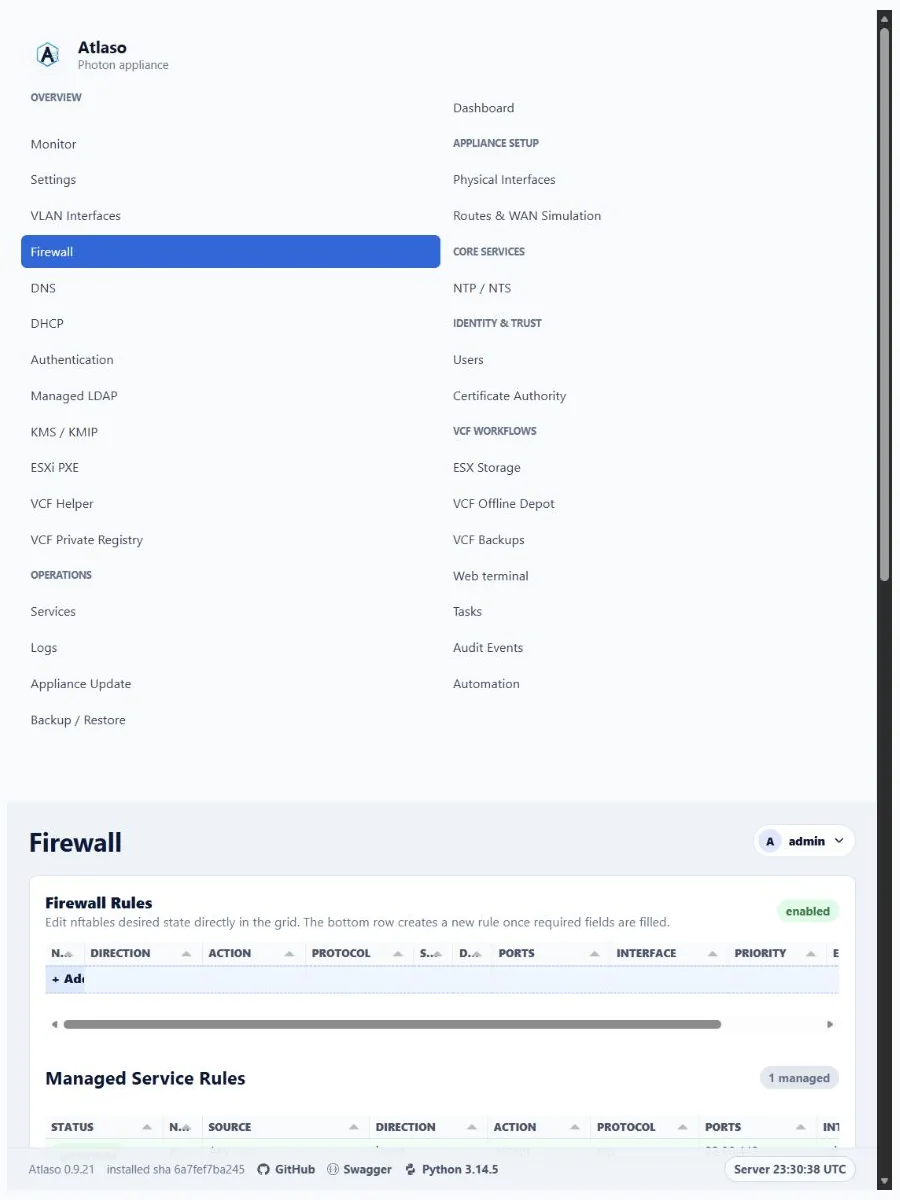
Figure: Firewall in the verified clean-appliance responsive state.