Managed LDAP for VCF Automation 9.1
Atlaso can operate a single OpenLDAP 2.6 service for VCF Automation while keeping each VCF organization in a separate LDAP naming context and LMDB database. This service is independent from Atlaso operator authentication: Atlaso sign-in remains local in v1.
Interface overview
This verified appliance view provides visual orientation before you begin.
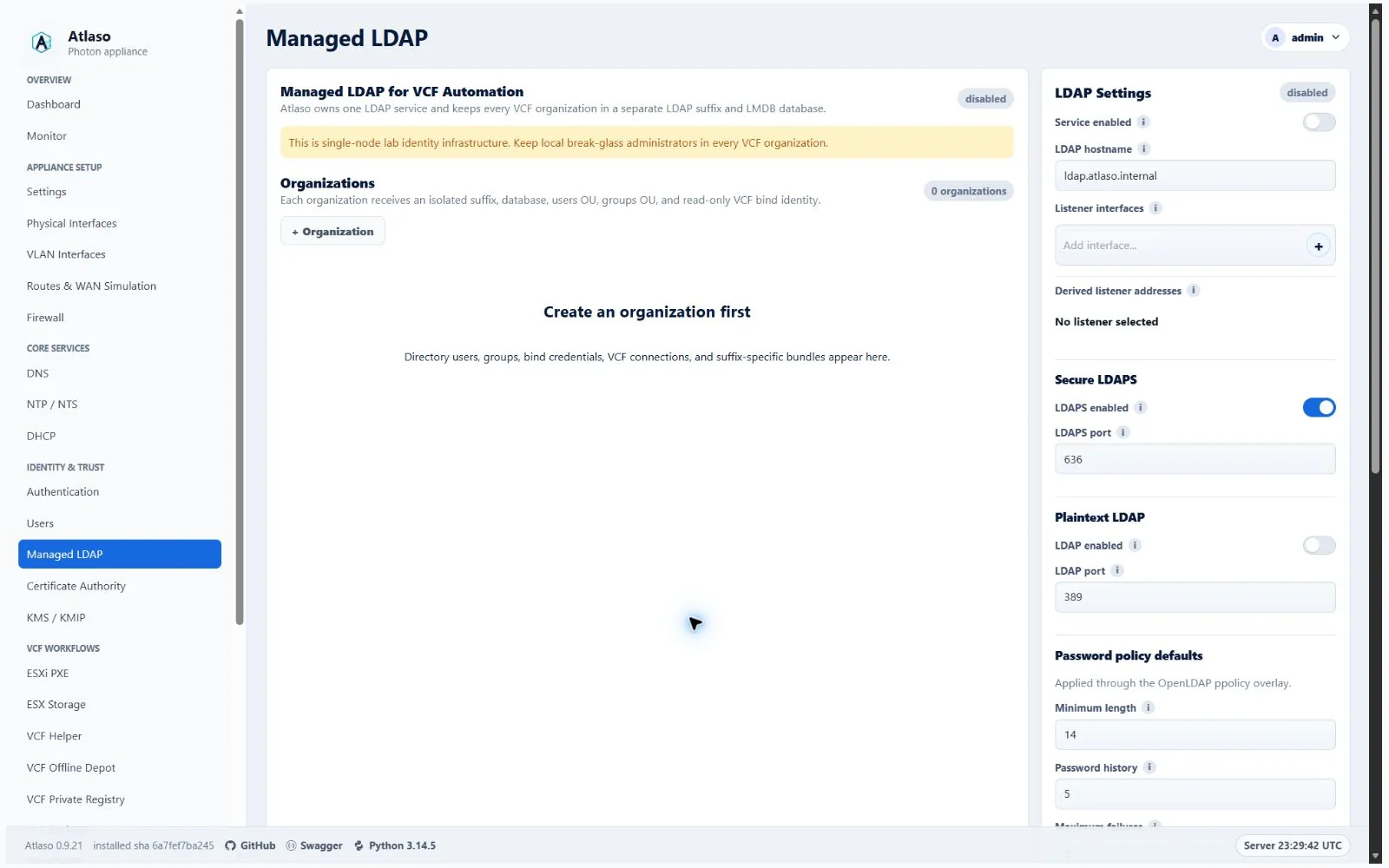
Figure: Managed LDAP in the verified clean-appliance desktop state.
Security boundary
- LDAPS is enabled by default on configurable TCP port 636 and uses a CA-managed certificate.
- Optional plaintext LDAP is disabled by default and has an independently configurable TCP port, defaulting to 389. Enabling it exposes credentials and directory data without transport encryption, so use it only on an isolated lab network when a client cannot use LDAPS.
- Privileged reconciliation uses local
ldapi:///with SASL EXTERNAL throughatlaso-helper ldap. - The integrated Atlaso CA issues the
ldap:ldapscertificate for the configured hostname and listener addresses whenever LDAPS is enabled. - Firewall apply owns rules for each enabled LDAP/LDAPS port on selected addressed access or route interfaces and enabled VLANs. Management interfaces are not eligible LDAP listener targets.
- Each organization receives a separate suffix and database. Its generated VCF bind identity can read only that suffix.
- VCF bind secrets are encrypted with
ATLASO_SECRETS_KEY. A generated or rotated secret is displayed once. - User passwords are held only in process memory until global LDAP apply. Password plaintext and hashes are never stored in the application database, previews, tasks, or audit details.
The default organization layout is:
dc=<organization>,dc=ldap,dc=atlaso,dc=internal
├── ou=users
├── ou=groups
├── ou=service-accounts
└── ou=system
Directory behavior
The helper generates one MDB database per enabled organization and configures the ppolicy, memberof, and
referential-integrity overlays. Groups use DN-valued member attributes and may contain users or groups. Atlaso rejects
cross-organization members and direct or indirect group cycles before save and again during helper validation.
The default password policy requires 14 characters with uppercase, lowercase, number, special-character, and username checks. Five failures lock a user for 15 minutes, and five previous passwords are retained. Expiry is disabled by default because v1 has no end-user password-change portal. Administrators can stage password resets, enable or disable users, and request an unlock; enforcement occurs only through global LDAP apply.
The Directory UI treats organizations like DNS zones: each organization is a tab and + Organization opens a guided
wizard for its name, operator description, isolated naming context, and enablement. Users and groups use
wizard-backed Tabulator grids with bottom add rows. Opening a saved row returns to the same reviewed flow, while the
Enabled column remains a direct edit for quick desired-state changes. Row menus retain password reset, unlock,
membership, and deletion actions. Group membership presents the selected organization's current users and eligible
nested groups, and new groups default to Enabled before review. User creation can stage a password or postpone it;
non-grid user and group creation returns to the selected organization using its saved identity. Enabling an account
without an applied or staged password causes LDAP apply validation to stop before host mutation.
Rapid organization-tab selections and browser back or forward navigation follow the latest selection. A superseded partial response cannot replace the selected organization, its URL, or its directory content. Returning to the initial queryless Managed LDAP URL restores the server-default organization through the same ordered load path.
The one-time VCF bind credential opens with its Bind password help collapsed and focus on Done, leaving the credential text unselected until the operator deliberately copies or saves it.
Generate test directory asks for user and group counts, invents complete synthetic identities and memberships, and shows generated passwords once; those passwords follow the same in-memory-only staging boundary as manually entered passwords. The result changes the primary action to Done, which closes the modal and clears the one-time CSV from the page. If Atlaso restarts before those passwords are applied, VCF Helper summarizes the affected users per organization and Recover missing passwords generates replacement credentials in one operation with a new one-time CSV.
VCF Automation integration
Open the Managed LDAP for VCF tile on the VCF Helper page for both manual bundles and the guided inspection, configuration, and verification workflow. The Managed LDAP page remains focused on directory service settings, organizations, accounts, and groups. Encrypted LDAP recovery is integrated into Backup / Restore as a separate LDAP-specific archive.
The VCF Helper presents organization selection, tenant connection, transient trust details, and the inspect-or-configure choice as separate reviewed wizard steps. Synthetic directory generation similarly separates organization selection, directory sizing, and the one-time credential warning before creation.
Every organization can download a manual ZIP bundle containing the selected VCF LDAP endpoint, root CA PEM when LDAPS is used, search bases, bind DN, VCF Automation 9.1 JSON, and operator instructions. The bind password is intentionally separate. Generated VCF settings prefer LDAPS whenever it is enabled; plaintext LDAP is used only when LDAPS is disabled and LDAP is enabled.
The guided workflow requires TLS 1.2 or newer while probing and pins the VCF Automation TLS SHA-256 fingerprint. The
fingerprint confirmation remains the trust decision; Atlaso does not silently replace it with ordinary CA
verification. The workflow reads current organization LDAP settings, requires explicit replacement approval, writes
settingsSource=DEFINED, tests LDAP, and verifies that VCF can find at least one user and group. Administrator
credentials are transient and are not stored.
The VCF 9.1 mapping includes:
Atlaso does not import LDAP groups into VCF or assign VCF organization roles. Complete those steps in VCF Automation and retain local break-glass administrators.
OIDC organization and group use
Managed LDAP can also supply identities to Atlaso's constrained OIDC provider. A bound OIDC client uses only its configured enabled organization and does not show an organization selector. An unbound client requires the user to choose Local or one currently enabled organization; duplicate usernames across organizations are therefore never used to infer a source.
The Authentication page maps selected managed LDAP groups to external OIDC group names. Atlaso evaluates current enabled
direct and nested membership through the same cycle-safe group graph used by the directory model. Organization mappings
are defaults; a compatible client-specific mapping replaces the default for the same LDAP group. Only mapped external
values are emitted when the client receives the groups scope. Raw LDAP group names, DNs, suffixes, listener details,
disabled groups, and unmapped groups remain private.
Apply and recovery
The ldap apply unit stages secret-bearing JSON at /var/lib/atlaso/apply/ldap/atlaso-ldap.json with mode 0600. The
file exists only for the constrained helper execution window. Atlaso and atlaso-helper remove it after success,
validation failure, or apply failure, and application startup removes stale input after an interrupted process. Raw
secrets remain excluded from previews, baselines, task payloads, logs, audits, and test output. When LDAP-related CA,
DNS, or firewall desired state changes, global appliance apply submits the changed dependency units together, including
when NTS server selection adds Certificate Authority to the task.
Normal settings backup contains LDAP metadata but no bind secrets or password hashes. Use the separate
passphrase-encrypted LDAP recovery export to preserve slapcat data. Recovery import decrypts and validates the archive
in memory, then stages it for the next global LDAP apply. A restart before apply requires the archive and passphrase
again. A rejected or failed settings-archive restore leaves the staged recovery metadata and in-memory payload intact;
only a successfully committed settings restore or factory reset clears it.
Additional verified states
These captures show responsive layouts and useful operational states referenced by this page.
Ldap: Groups
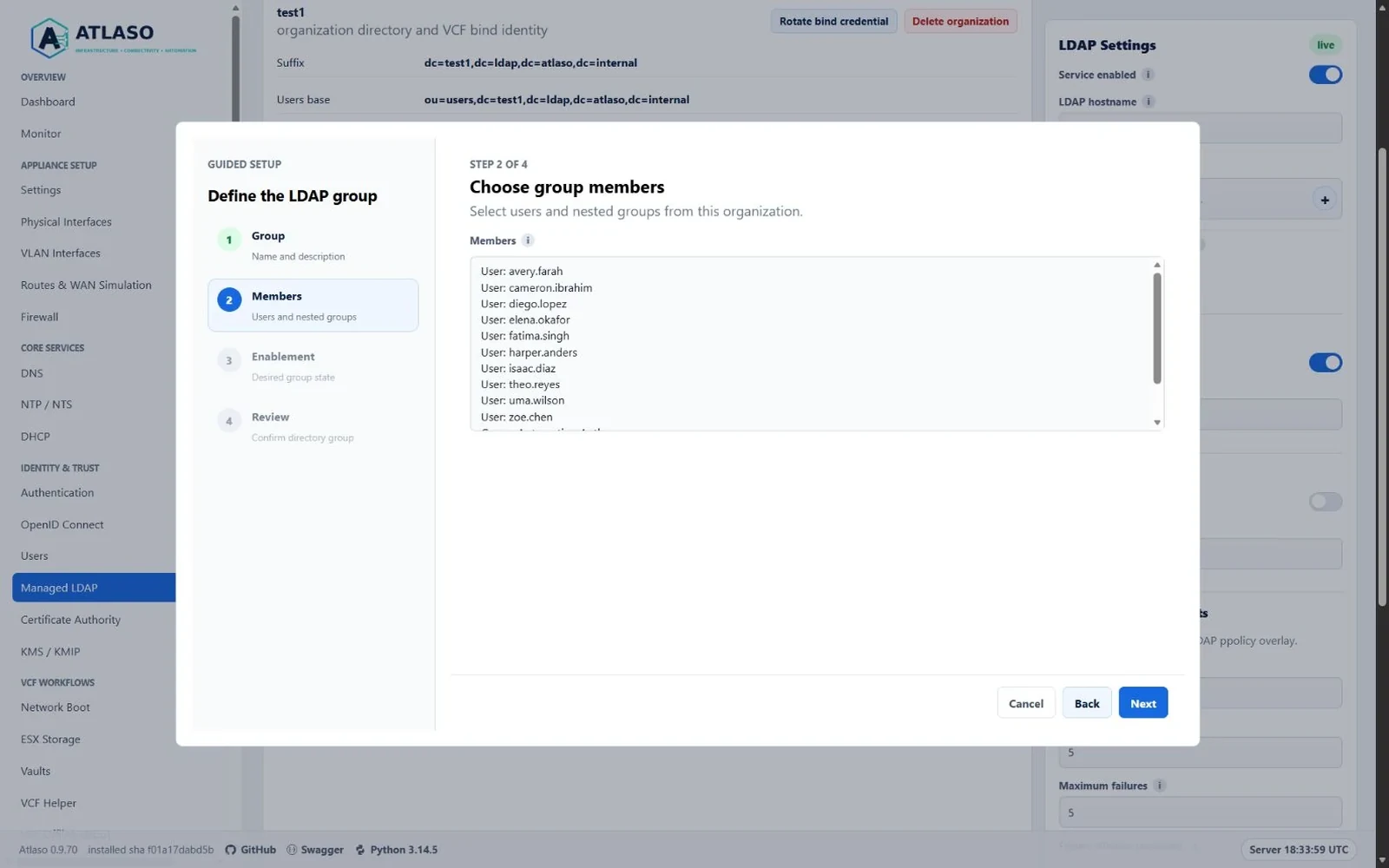
Figure: Managed LDAP group wizard populated with selectable users and nested groups.
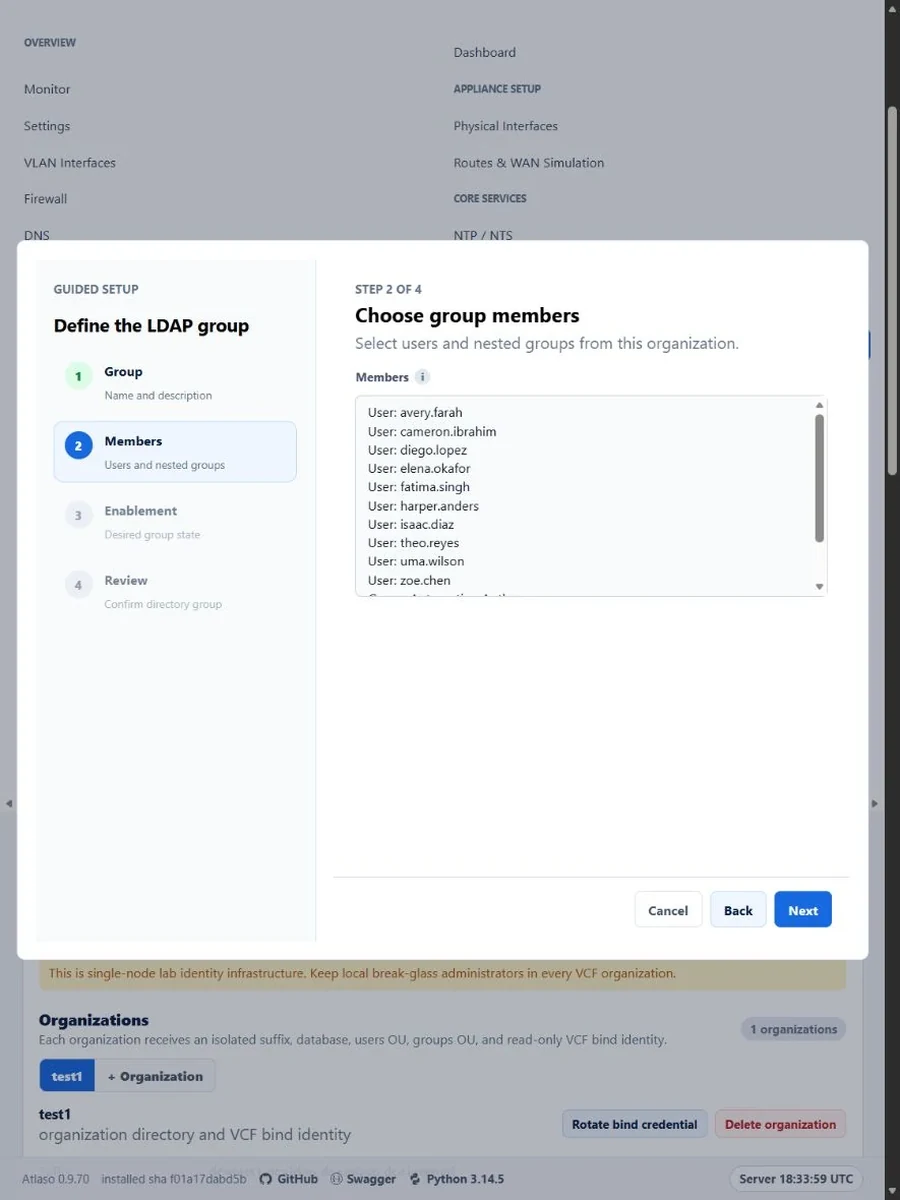
Figure: Managed LDAP group Members step in the verified narrow viewport.
Managed LDAP
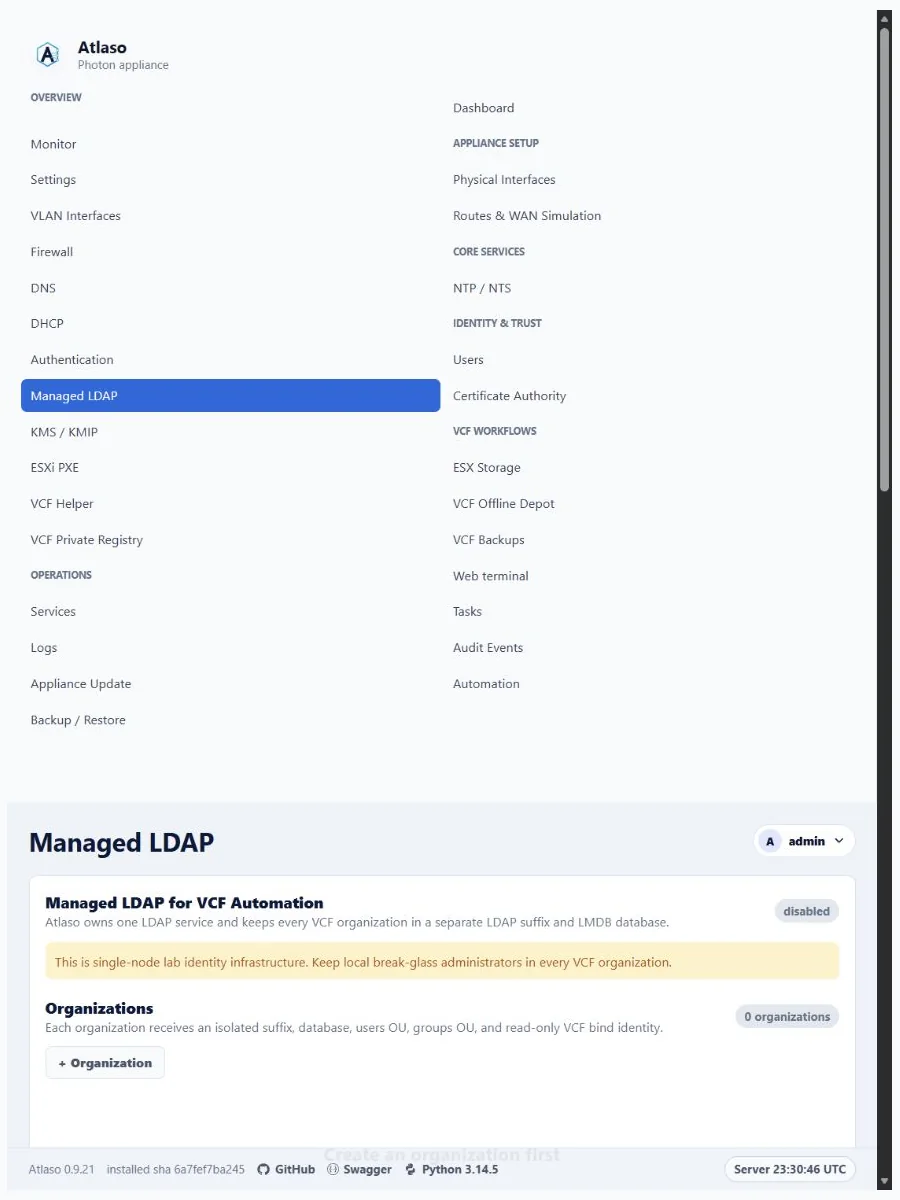
Figure: Managed LDAP in the verified clean-appliance responsive state.