VCF Helper
VCF Helper prepares deployment DNS desired state. It is available under VCF Workflows at
/ui/management/vcf-helper.
Interface overview
This verified appliance view provides visual orientation before you begin.
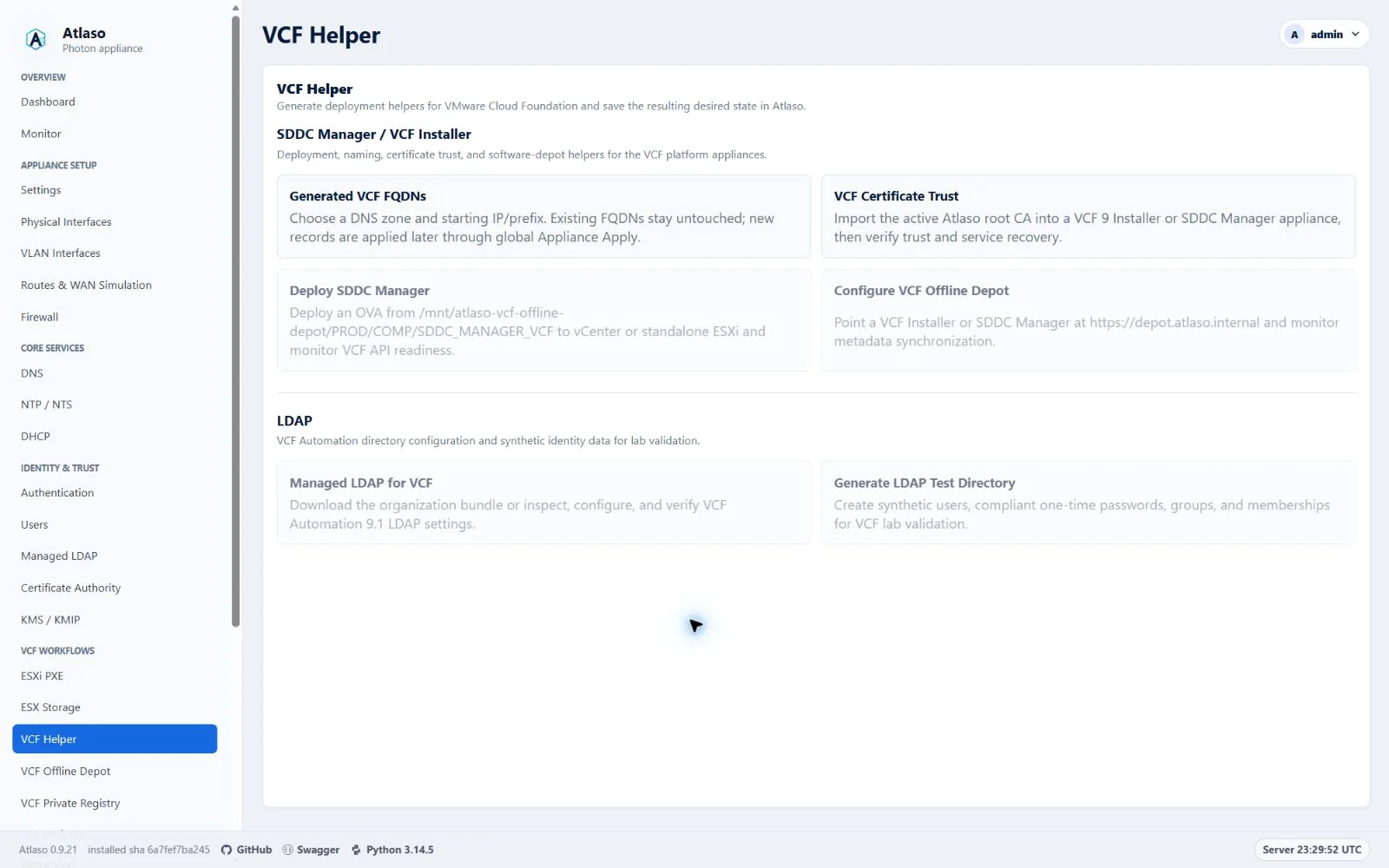
Figure: VCF Helper in the verified clean-appliance desktop state.
Administrators can also use Import passwords into a vault for VCF 9 SDDC Manager and VCF Installer appliances. The wizard chooses vault or manual credentials first, confirms the server second, and then opens a dedicated TLS page. Atlaso probes the server without resolving or sending credentials and requires the operator to confirm the observed fingerprint before vault or manual authentication can continue. The probe requires TLS 1.2 or newer, and explicit fingerprint confirmation remains the trust decision rather than being replaced with ordinary CA verification. It displays only discovered metadata for selection, then re-fetches and encrypts the reviewed VCF/ESX passwords in the selected vault. Source credentials are request-local and password values are never included in the discovery response. See Vaults for supported entries, managed-script and Kickstart access, URI targets, and restore behavior.
The helper creates DNS records in Atlaso, deploys SDDC Manager OVAs, and configures VCF 9 appliances to use the applied
local offline depot. DNS does not reload dnsmasq or change the appliance directly. Review and submit the changed
DNS/DHCP (dnsmasq) unit through the global /ui/management/appliance-apply workflow after generation or deletion.
The VCF Certificate Trust button opens the separate remote certificate task in a modal without mixing CA details into
the main DNS helper workspace. See VCF Certificate Trust.
Use a saved vault credential
An administrator can select Vault and then Key anywhere VCF Helper requests a remote vCenter, ESXi, SDDC Manager, VCF Installer, or VCF Automation login. Atlaso fills the server from the HTTP or HTTPS URI selected for the entry and fills its username. The server control is read-only, the manual-login controls are disabled, and the login page is skipped. The picker omits keys without an HTTP or HTTPS URI and shows one choice per valid URI when a key has several. If the selected vault has no usable keys, it shows No HTTP/HTTPS credentials available and keeps manual mode active.
Address fields display only the selected hostname, IP, and non-default port; they do not display http:// or
https://. Fields explicitly labeled as a URL, such as VCF Automation URL, retain the complete URL.
The selected password is not loaded into the page, copied into the password input, or returned by an API. The disabled password input indicates that the stored value will be used. Atlaso validates that the key belongs to the selected vault, decrypts the password on the server for that request only, and records the use without recording the value. Choose Enter credentials manually to return to request-local username and password entry. Service administrators can continue to use manual credentials but cannot select administrator-owned vault entries.
Remote VCF wizards consistently use Credential, Server, TLS fingerprint, and Login as their first four steps. The TLS step is always pre-authentication. Workflow-specific selection and review pages follow it.
The picker is available for SDDC Manager deployment inventory, VCF Offline Depot configuration, VCF Certificate Trust, VCF password import source authentication, and Managed LDAP for VCF Automation. The local offline-depot HTTP password and OVA appliance passwords remain separate fields and are never filled from this picker.
Deploy SDDC Manager
Deploy SDDC Manager becomes available when a valid OVA is present beneath
/mnt/atlaso-vcf-offline-depot/PROD/COMP/SDDC_MANAGER_VCF. Atlaso validates the OVA manifest, reads its
user-configurable OVF properties, confirms the vCenter or ESXi TLS fingerprint, discovers destination inventory, and
streams the disks through a vSphere NFC lease. The pre-authentication fingerprint probe requires TLS 1.2 or newer while
preserving explicit fingerprint confirmation as the trust decision. It refuses duplicate VM names, powers on the VM,
and waits up to 90 minutes for the VCF API.
The form can optionally add managed DNS desired state, deploy Atlaso CA trust, and configure the local offline depot. Trust uses the VCF API only and does not require a snapshot acknowledgement. Manually entered vSphere, OVF, VCF API, and depot passwords remain transient; a selected vault password remains encrypted at rest and is resolved only on the server for the request.
Configure VCF Offline Depot
The standalone helper is available only when the local depot is enabled, applied, CA-backed, has a generated software depot ID, and has a selected HTTP user. Its wizard follows Credential, Server, TLS fingerprint, and Login before collecting the one-time depot HTTP password and reading the current sanitized depot configuration. The TLS probe runs before Atlaso resolves a selected vault password or reads manual login fields. After confirmation, Atlaso detects VCF Installer or SDDC Manager 9.x. Replacing a different depot requires explicit confirmation.
Atlaso calls PUT /v1/system/settings/depot, triggers metadata refresh with
PATCH /v1/system/settings/depot/depot-sync-info, and polls the matching GET endpoint for up to 60 minutes. It asks for
the local depot user's password for each run and never stores it. Certificate trust is not implicit; configure it
separately when the target does not yet trust the Atlaso CA.
Generate FQDNs
Open Generated VCF FQDNs and select:
- the deployment catalog;
- an optional hostname prefix and suffix;
- a domain from the DNS zones managed by Atlaso;
- a starting IPv4 or IPv6 address with its CIDR prefix, such as
192.168.50.100/24or2001:db8:50::100/64.
The preview updates as the deployment, prefix, suffix, or domain changes. A generated hostname is formed as:
For example, prefix lab-, hostname vc01, suffix -mgmt, and domain example.internal produce
lab-vc01-mgmt.example.internal.
Creating records requires confirmation. The modal remains open after creation so assigned addresses can be reviewed.
When every displayed FQDN has an A or AAAA address, the primary action changes to Done; Done closes the modal.
Deployment Catalogs
The catalog is versioned so later VCF and VVF releases can define different component sets without changing existing selections.
| Hostname | Component description | VCF 9.1 | VVF 9.1 |
|---|---|---|---|
vc01 |
vCenter | Yes | Yes |
nsx01 |
NSX Manager cluster | Yes | No |
nsx02 |
NSX Manager appliance 1 | Yes | No |
nsx03 |
NSX Manager appliance 2 | Yes | No |
nsx04 |
NSX Manager appliance 3 | Yes | No |
ops01 |
VCF Operations primary node | Yes | Yes |
ops02 |
VCF Operations replica node | Yes | No |
ops03 |
VCF Operations data node | Yes | No |
collector |
Cloud Proxy | Yes | No |
auto-vip |
VCF Automation | Yes | No |
auto-platform |
VCF Automation Runtime | Yes | No |
sddcm |
SDDC Manager | Yes | No |
vsp01 |
VCF services runtime | Yes | Yes |
fleetlcm |
Fleet components | Yes | Yes |
shared01 |
Instance components | Yes | Yes |
vidb |
Identity Broker | Yes | No |
license |
License Server | Yes | Yes |
Address Allocation
An IPv4 starting CIDR creates A records. An IPv6 starting CIDR creates AAAA records. Allocation starts at the entered address and advances sequentially within that network.
Atlaso skips:
- addresses already used by DNS records of the selected address family;
- IPv4 addresses used by DHCP reservations;
- generated FQDNs that already exist as any DNS record type.
Existing FQDNs are never overwritten. Existing A and AAAA addresses are shown in the preview when available. If the remaining network cannot provide an address for every missing FQDN, allocation fails transactionally and creates no records.
IPv4 network and broadcast addresses are not allocatable. The IPv6 network address is treated as the subnet-router anycast address and is not allocatable.
Record Ownership And Deletion
New records use the catalog component description, such as vCenter or VCF Automation, as the DNS record description.
Helper ownership is stored separately in structured record metadata with source vcf_helper and the catalog component
hostname.
Delete generated records is enabled only when at least one displayed FQDN has an A or AAAA address. Deletion requires
confirmation and removes only records owned by VCF Helper for the selected deployment, prefix, suffix, and domain.
Unrelated or manually created records are preserved. Legacy helper records without ownership metadata are removed only
when their description exactly matches the expected component description.
Routes And Responses
GET /ui/management/vcf-helperrenders the helper page.POST /ui/management/vcf-helper/generated-fqdnsvalidates and creates missing records.POST /ui/management/vcf-helper/generated-fqdns/deletedeletes matching helper-owned records.POST /ui/management/vcf-helper/sddc-manager/inventoryconfirms TLS and discovers vSphere inventory.POST /ui/management/vcf-helper/sddc-manager/deployqueues an OVA deployment.GET /ui/management/vcf-helper/sddc-manager/tasks/{job_id}reports deployment progress.POST /ui/management/vcf-helper/offline-depot/inspect-targetpreviews remote depot state.POST /ui/management/vcf-helper/offline-depot/configurequeues remote depot configuration.GET /ui/management/vcf-helper/offline-depot/tasks/{job_id}reports configuration and sync progress.
Fetch responses report created, skipped, deleted, and preserved rows with their assigned addresses, plus validation or allocation errors. All mutations use the existing authenticated session, CSRF validation, audit logging, and DNS desired state model.
Additional verified states
These captures show responsive layouts and useful operational states referenced by this page.
VCF Helper
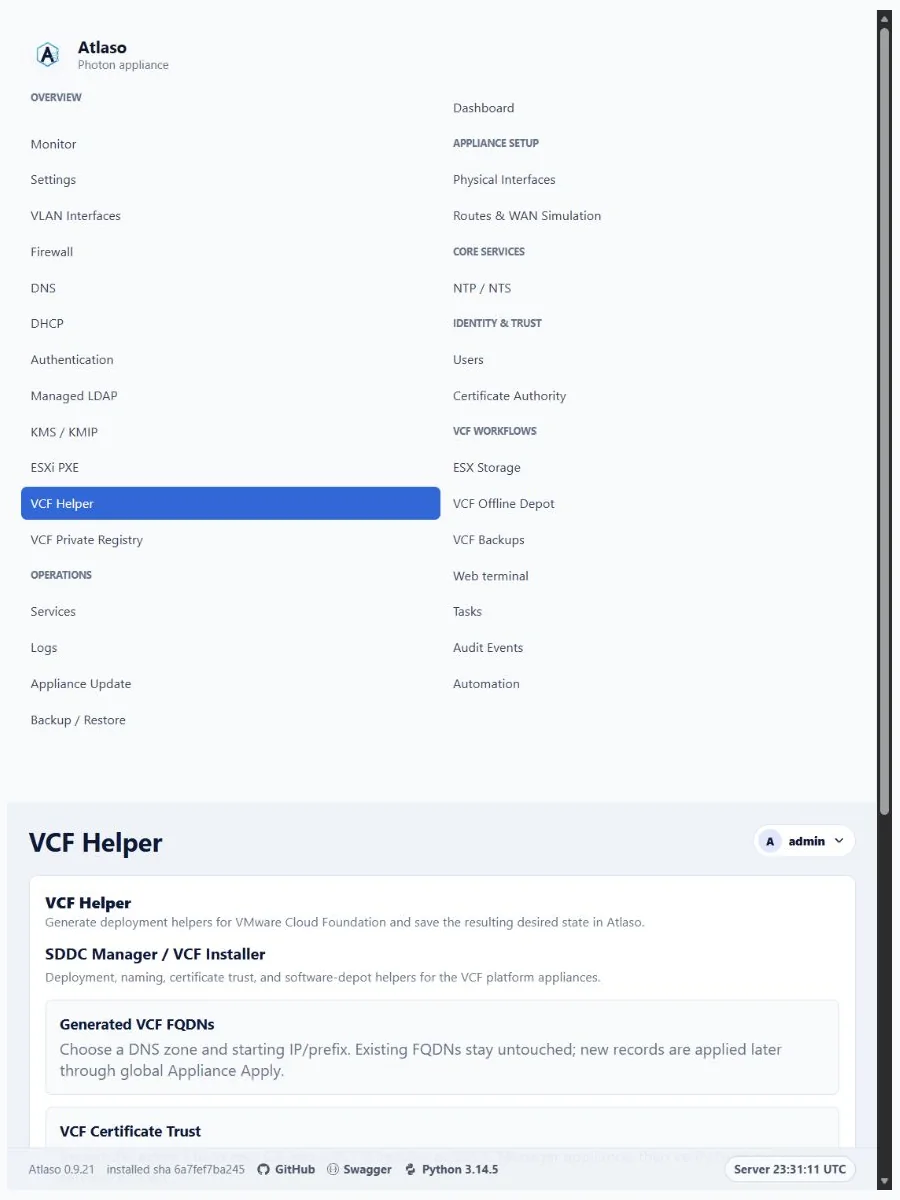
Figure: VCF Helper in the verified clean-appliance responsive state.