Traffic Publishing
Use Traffic Publishing at /ui/management/traffic-publishing to configure source NAT and port forwarding.
Routing & WAN
at /ui/management/routes-wan owns static routes, routing permissions, forwarding, and WAN simulation. Traffic
Publishing requires Firewall read permission; changing its browser settings or rules requires Firewall write permission.
Interface overview
This verified appliance view provides visual orientation before you begin.
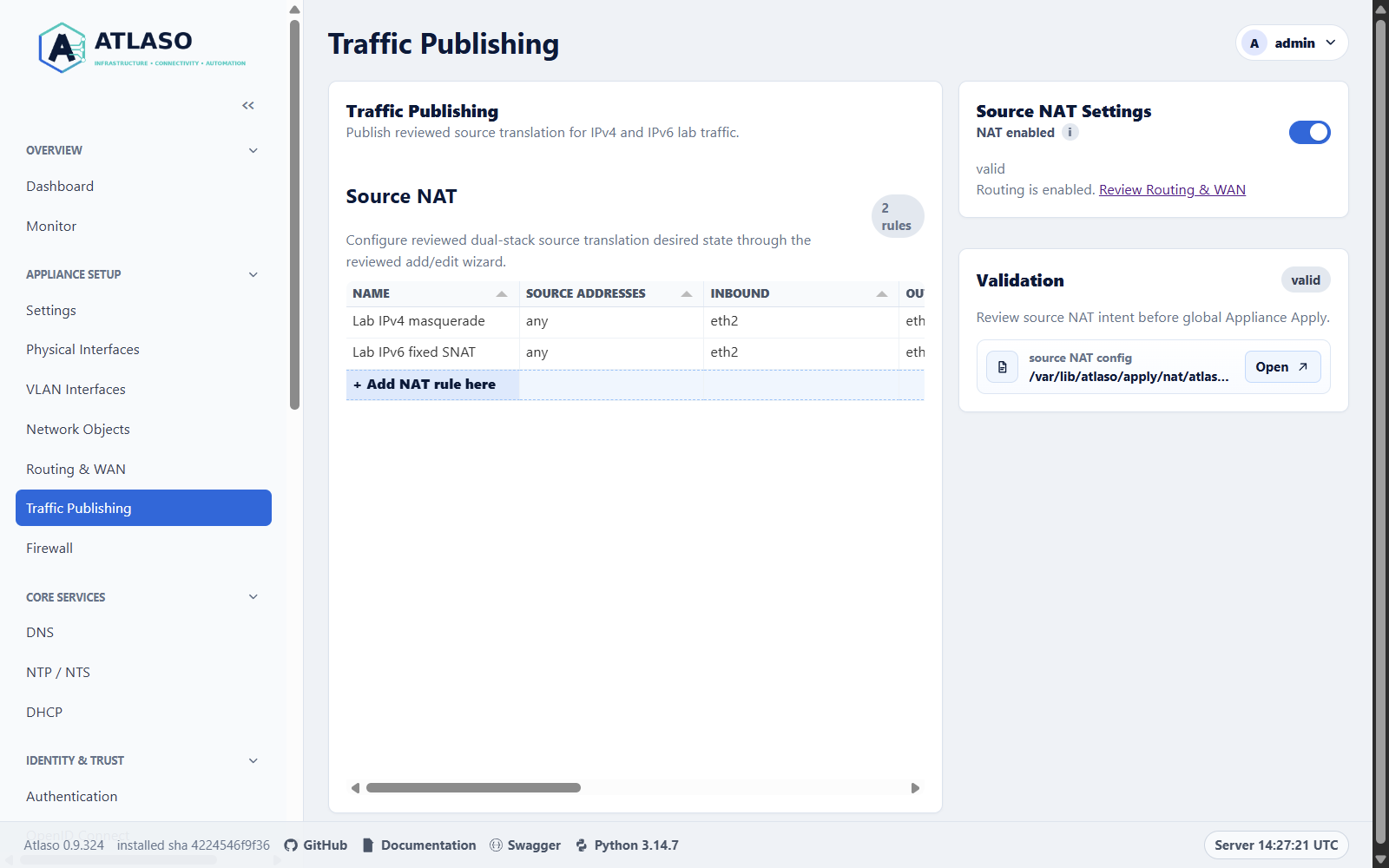
Figure: Traffic Publishing with reviewed IPv4 masquerade and the canonical NAT setting.
Managed HTTP/HTTPS reverse proxies are tracked by issue #723. The reverse-proxy workflow describes their desired-state collection, trust choices, cached health, and native acceptance requirements. The branch implementation publishes them through global Appliance Apply; native appliance acceptance remains pending, so this page makes no claim about a released appliance.
Configure source translation
- Configure two distinct addressed lab targets in Physical Interfaces or VLAN Interfaces. Use enabled
accessorroutetargets. A VLAN also needs an available, enabled trunk parent. Dedicated management, unused, missing, disabled, and unaddressed targets are excluded. Access-management flags do not exclude an eligible access target. - The desktop grid fills the available viewport height and resizes with its panel. Narrow layouts use a compact height. Add a rule from the Source NAT grid's bottom row, or open an existing rule to edit it.
- Select IP family: IPv4 or IPv6. Select every intended Inbound interface or VLAN and one distinct Outbound interface or VLAN with addresses in that family.
- Select any same-family source, a shared Source Group, or explicit same-family source CIDRs. A Source Group must resolve entirely within the selected family. These selectors restrict addresses inside the selected ingress; they never grant access from another interface. Manage source groups opens Network Objects in a new tab. Return to the wizard to refresh the source-group choices while preserving the rule draft.
- Select Interface-address masquerade, or Fixed SNAT and choose the exact same-family address assigned to the egress target. The address selector refreshes when the family or egress changes and does not accept arbitrary text. Fixed SNAT does not assign an address or create a pool. IPv6 translation is stateful NAT66. Saved rules retain unavailable translated addresses so you can reach State and disable them. An enabled final state requires available targets and an assigned address; changing family, egress, or mode clears the saved choice.
- Review the family, ingress, source, egress, translation, priority, and enabled state, then save.
- Enable NAT enabled and enable Routing in Routing & WAN when forwarding is intended. Both switches default off. Routing is the sole owner of IPv4 and IPv6 forwarding. NAT intent remains saved and visibly suspended while Routing is off; WAN simulation remains independent.
- Review global Appliance Apply and submit Traffic Publishing (
nat). Changed Network and Routing dependencies join the submission so the translation snapshot matches target and forwarding state. Management changes retain the protected management handoff. Firewall Apply also replays Traffic Publishing after replacing the firewall ruleset, even when NAT desired state is unchanged.
Saving only changes desired state. There is no rule-specific Apply action. Disabled features preserve their rows. Every rendered rule includes explicit ingress selectors, so appliance-originated traffic cannot match it. This page does not configure proxies, address pools, or NPTv6.
Configure port forwarding
- Select the Port Forwarding tab and add a rule. Enter its name, purpose, and priority.
Descriptions allow 1,000 UTF-16 code units in both the browser and API; an emoji outside the BMP uses two units.
API clients should enforce
x-maxLengthUtf16CodeUnitsfrom the request schema. - Choose IPv4 or IPv6, one eligible addressed ingress interface or VLAN, and its exact listener address. Dedicated management interfaces are excluded. An access interface with the management UI flag remains eligible, but Atlaso service listener ports cannot be redirected.
- Choose TCP or UDP and the external port range. Enter the same-family target address and an equally sized target
port range. For example,
12000–12002to13000–13002maps each port by its offset. The target must be another host and cannot be a dedicated management-network address. IPv6 forwarding uses stateful NAT66. - Choose Any, a shared Source Group, or explicit same-family CIDRs. The source restriction applies only inside the selected ingress boundary. Overlapping enabled listeners are rejected even when their source restrictions differ.
- Keep Preserve client source unless the target's return path requires reply masquerade. With preservation, arrange the target's route back to the client through Atlaso. Masquerade replaces the original client source; selecting it requires an explicit acknowledgement before saving.
- Review the complete mapping and enablement. New rules default disabled. Save desired state, then use global Appliance Apply. Routing must be enabled for activation; the Source NAT enable switch does not control port forwards.
Firewall rule names may contain generated admission marker text; only complete standalone marker lines delimit the generated block. Custom service ports reserve their configured listener addresses, allowing an independent forward on the other address family; standard appliance protocol ports remain reserved across both families. Firewall shows generated admission attributed to the owning port forward. These rows are read-only; edit their source boundary and listener in Traffic Publishing. Apply captures Firewall and NAT together, validates their complete program, and publishes both atomically. It commits both application baselines before acknowledging the root-owned recovery record. Management changes include this pair in the protected management handoff and its wider rollback. Both ordinary Apply and management handoff preserve connections for unchanged mappings and retire only changed IDs. Live IPv4 wildcard sockets block only IPv4 mappings. IPv6 and unspecified wildcards remain reserved for either family when the socket observation cannot establish IPv6-only ownership. Handoff failures before paired publication skip connection retirement; later rollback retires only candidate changes. When reusing a service endpoint, select its shutdown or listener change in the same Apply. Selected listener services run before forwarding publication so the live socket check observes the released endpoint. During a management handoff, only service shutdowns run early. Enabled certificate consumers, including KMS and NTS, wait for the CA-bearing handoff. Desired listener collision checks still protect forwarding publication; an existing socket conflict blocks publication, so release that endpoint in a separate Apply before moving an enabled listener. Startup also reconciles an interrupted first publication when its recovery journal exists but no NAT snapshot was written, restoring the previous Firewall before application-level recovery. Inventory reconciliation follows a verified NIC rename, including child VLAN listeners, and refreshes each changed forward's desired-state update timestamp. Reconciliation without a binding change preserves the timestamp. A missing NIC keeps its inert identity and exact mapping, disables the forward, and requires operator review before reactivation. The grid's Review column identifies these rules as Review restored listener, matching the no-JavaScript table. Archives must use canonical listener and target IP literals, including lowercase compressed IPv6, matching runtime validation. Noncanonical archived literals are rejected before any desired-state replacement.
Removing, disabling, or suspending a rule retires its counters and Atlaso-marked connections during Apply. Sessions
through that mapping must reconnect. Unchanged mappings retain their connections during unrelated Apply submissions;
edits retire only changed rule marks. This retirement never flushes unrelated connection tracking. Appliance
images and wheel deployments include conntrack-tools; its daemon is not required. An unavailable retirement tool
blocks publication rather than leaving stale translations active.
Refresh status after applying. A missing lab route or a failed target/next-hop neighbor produces a degraded warning while keeping the safe mapping applied. Review Routing & WAN, the target address, power, and connectivity. A present route or an unresolved neighbor does not prove application health: test from an allowed client and check the target service. Status performs bounded read-only observations and does not probe target ports.
Archives preserve complete mappings and source references. An unavailable restored interface relationship remains
saved but disabled and marked for review. Disabled rules with an available listener still validate Source Groups,
appliance-owned targets, and listener collisions before restore changes desired state. Only bindings identified as
unavailable during import may skip the ingress assignment check; an archived review flag does not grant that exception.
Source references, target restrictions, and reserved-listener checks still apply when the ingress is unavailable.
Older v2 archives without a port_forwards section restore an empty forwarding collection, replacing any current
desired mappings. Other required sections and explicitly malformed forwarding sections remain subject to validation.
Global Apply reads a bounded privileged projection of durable runtime intent when selecting paired Firewall/NAT
publication. The application does not open root-owned snapshots. An unavailable projection blocks submission instead
of implicitly selecting additional units; source-NAT-only intent does not expand a listener-only selection.
Disabled-only or Routing-suspended mappings do not add paired publication dependencies. Independent selections such as
Local Users do not query forwarding runtime readiness. Previously effective applied mappings still require paired retirement.
Clearing desired rules and Apply baselines through restore still retires previously applied forwards through the
paired path.
Factory reset removes desired mappings and retires their runtime state before
replacing interface configuration. A pending publication recovery must be reconciled before reset can continue.
Verify and recover
At boot, the NAT replay service runs after Routing & WAN and before Atlaso startup. Atlaso's subsequent startup reconciliation therefore verifies the saved NAT state without racing the replay service.
Inspect the global task result and nft list table ip atlaso_nat and nft list table ip6 atlaso_nat on the appliance.
Use traffic from a selected ingress to verify the translated source and return path. Also verify that another ingress,
the dedicated management interface, the wrong family, and appliance-local traffic do not match. Existing connection
tracking can retain an established flow's prior translation; use new connections when testing changed rules.
The NAT helper captures staged input once and uses that same snapshot for validation, rendering, and persistence. It validates the captured configuration, verifies each physical MAC and live interface index, and verifies that a fixed address is actually assigned to the live egress. It atomically replaces the two Atlaso-owned NAT tables without replacing unrelated nftables tables. A durable recovery record restores the previous configuration, runtime program, and service enablement if persistence or activation fails. Failed recovery remains actionable.
Successful Apply persists /etc/atlaso/traffic-publishing/atlaso-nat.conf and enables atlaso-nat.service only while
source NAT or port-forward intent is enabled. Disabling Source NAT does not disable port forwards. Factory reset clears
both kinds of translation. Boot and
control-plane startup rebuild selectors using current interface indexes. A replaced or missing NIC, or an unavailable
fixed address, quarantines translation and requires review. The saved desired rule is preserved. Do not hand-edit
/etc/atlaso/nftables.d/atlaso-nat.nft; the managed include path remains stable.
Management handoff rollback restores Firewall before replaying NAT, so a firewall ruleset replacement cannot erase the restored source translations.
Upgrade, archives, and API compatibility
Port-forward API
The /api/v1/traffic-publishing/port-forwards collection owns destination-translation intent independently of the
legacy source NAT collection. List and read operations require read:firewall; create, replace, and delete require
write:firewall. WAN permission does not grant access to these operations.
| Operation | Meaning |
|---|---|
GET /api/v1/traffic-publishing/port-forwards |
List up to 256 saved rules, including disabled intent. |
POST /api/v1/traffic-publishing/port-forwards |
Validate and create a complete rule; return 201. |
GET /api/v1/traffic-publishing/port-forwards/{id} |
Read one saved rule; return 404 when absent. |
PUT /api/v1/traffic-publishing/port-forwards/{id} |
Validate and atomically replace the complete saved rule. |
DELETE /api/v1/traffic-publishing/port-forwards/{id} |
Delete desired intent and return 204 without a body. |
GET /api/v1/traffic-publishing/port-forwards/status |
Compare current intent with bounded applied observations. |
A complete rule names one IP family, exact assigned ingress listener, TCP or UDP, ordered external and target port ranges of equal length, and a same-family target address. Each external port maps to the target port at the same offset. Source restrictions may use Any, a shared Source Group, or up to 128 same-family CIDRs. Source Groups containing both families are rejected instead of silently filtering their members. Enabled rules cannot overlap on the same family, listener, protocol, and external ports, even when their source restrictions differ. At most 65,535 external ports may be mapped across enabled rules.
reply_mode=preserve keeps the original client address. Selecting reply_mode=masquerade requires
acknowledge_source_loss=true in the create or replacement request. The acknowledgement is request-only. New rules
default disabled. Validation failures use ProblemDetails and preserve the previous row and its audit history.
Complete replacements revalidate bindings, source restrictions, target safety, and listener collisions even when
disabled. Archive restoration and missing-NIC reconciliation may retain unavailable disabled relationships for review.
Saving never invokes host enforcement; global Appliance Apply owns translation changes.
Successful replacements, including enable/disable changes, refresh the API's updated_at timestamp.
Signed upgrades install missing conntrack-tools through the candidate service's pre-start hook, including upgrades
performed by older installed helpers. Existing installations are reused. Installation failure blocks candidate startup
and leaves the upgrade's normal rollback path responsible for recovery; restore Photon repository access before retrying.
Status distinguishes disabled, pending, suspended, applied, and degraded records. An edited target or source boundary does not inherit the previous mapping's counters. Packet and byte counts are nullable: unavailable observations are not reported as zero. Applied status requires the DNAT rule, both generated Firewall admission directions, and the owned counter and both guard admission directions to remain present in one runtime snapshot. Missing members report degraded even if counters survive. The observed DNAT predicates, translated address and port mapping, source boundary, and connection mark must also match the saved mapping; retaining a generated comment alone does not establish applied state. The family-specific postrouting rule must retain the exact private mark, DNAT status predicate, and saved preserve or masquerade action. Missing or changed reply handling reports degraded state even when DNAT and admissions remain. Both guard and Firewall admissions must match the complete original tuple, source boundary, private mark, connection direction, DNAT status, and ingress or return interface. Changed predicates report degraded state. When Firewall is disabled, paired Apply creates a minimal accept-policy forwarding chain with the generated admissions; this preserves disabled Firewall behavior while retaining complete forwarding observation. The captured Firewall preview includes that minimal chain and both admissions, matching the paired Apply program. If the interactive grid fails to load, its fallback remains readable; deletion is available only through the grid's confirmed action. Listener-related Apply preflight also reads NAT status when no forwarding rules are saved, so it can detect mappings retained from an earlier runtime. An unavailable status blocks submission until helper readiness is restored. The page summary includes enabled port forwards independently of source NAT and reports their validation errors. These counters describe matched traffic, not proof that an application at the target is healthy.
Source NAT compatibility
Existing IPv4 rules gain ip_family=4, translation_mode=masquerade, and an empty translated_address. Existing
explicit NAT enablement migrates to the single traffic_publishing.nat_enabled setting. When neither global switch
exists, enabled legacy NAT rules preserve inferred activation; explicit disable and factory reset still take
precedence. A rule without explicit ingress stays saved for review and cannot become active until its ingress is
selected. Archives preserve rules and missing identities backed by archived host inventory; restoring them does not
make those identities runtime-eligible. Factory reset disables NAT and clears its desired rules through the normal
reset and Apply lifecycle.
GET and PUT /api/v1/traffic-publishing/settings use read:firewall and write:firewall. The response exposes
nat_enabled, routing_enabled, effective_nat_enabled, and suspended; only nat_enabled is writable. These are
desired-state values, not a live-health assertion. Validation failures use ProblemDetails.
Existing /api/v1/nat/rules paths, operation IDs, and read:wan / write:wan authorization remain compatible. The
family, mode, and translated-address fields are additive. Older IPv4 request bodies retain their defaults. Rule PATCH
preserves omitted ingress, family, mode, and translated-address fields. masquerade remains a compatibility mirror.
RoutesWanSettings.nat_enabled is deprecated and projects the same canonical setting; legacy writes update that
setting in the same desired-state transaction. It does not create a second NAT owner.
Existing Routes/WAN NAT form submissions are internally handled and return a same-host 303 to Traffic Publishing;
mutations are never replayed through 307 or 308. Use the canonical Traffic Publishing bookmark for the rule grid.
Additional verified states
These captures show responsive layouts and useful operational states referenced by this page.
Traffic Publishing
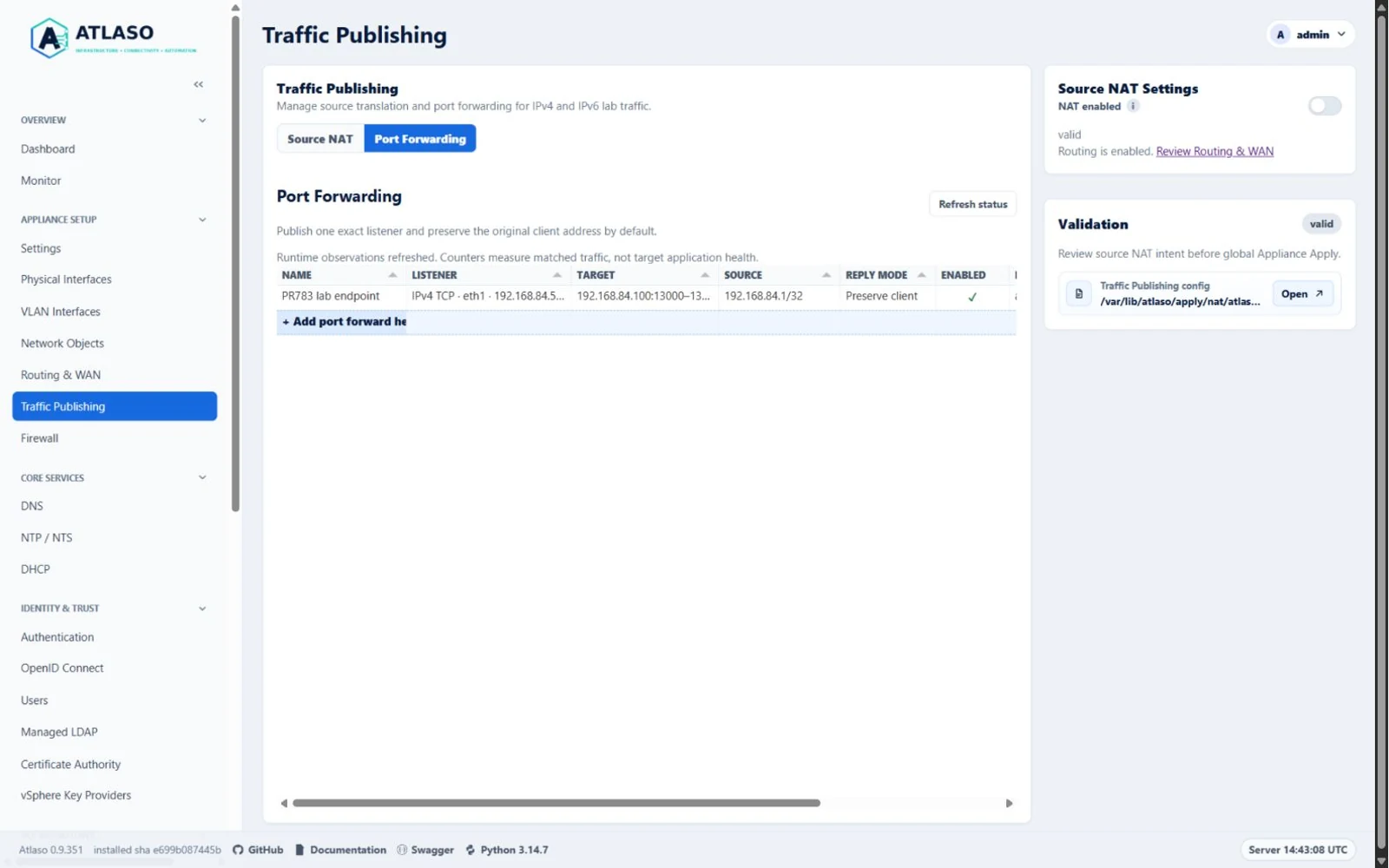
Figure: Port Forwarding is independent of source NAT; counters do not prove target health.
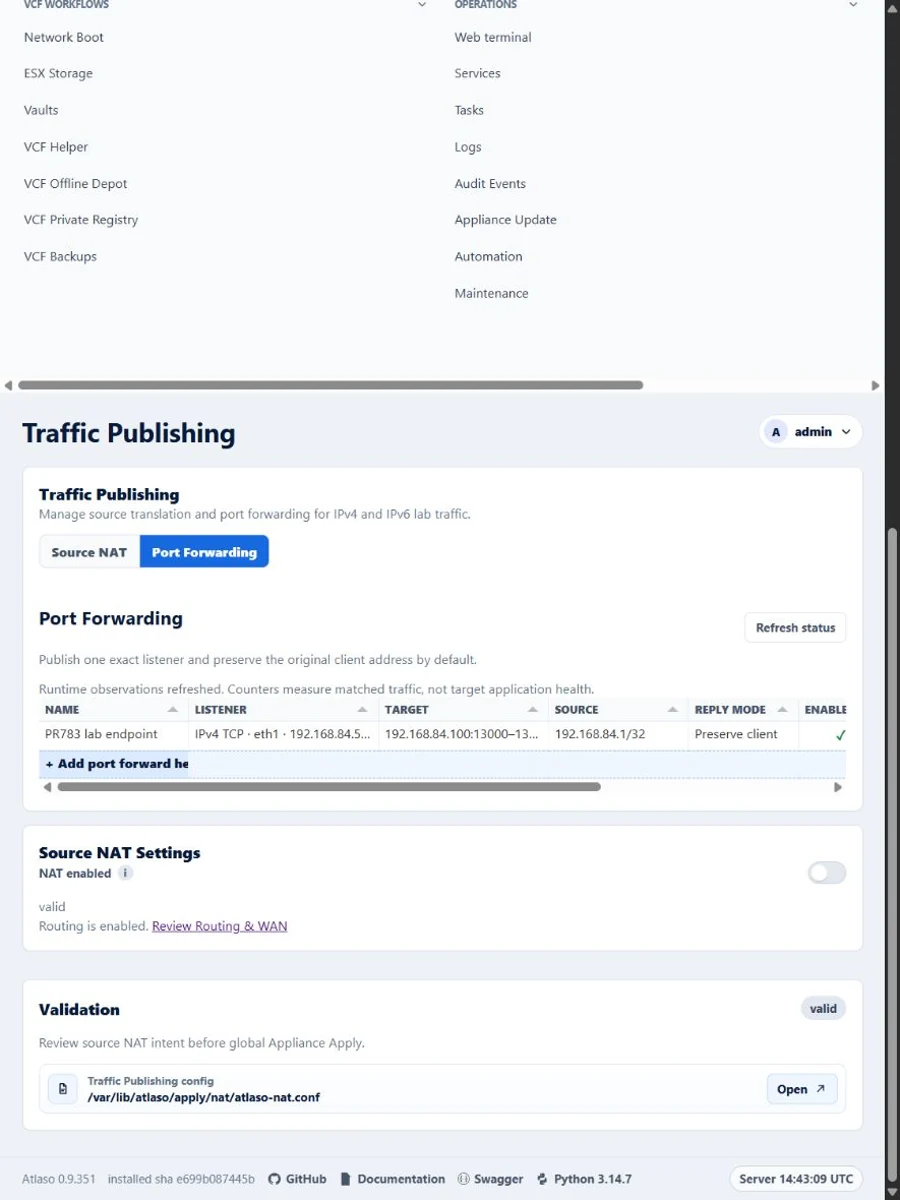
Figure: Port Forwarding is independent of source NAT; counters do not prove target health.
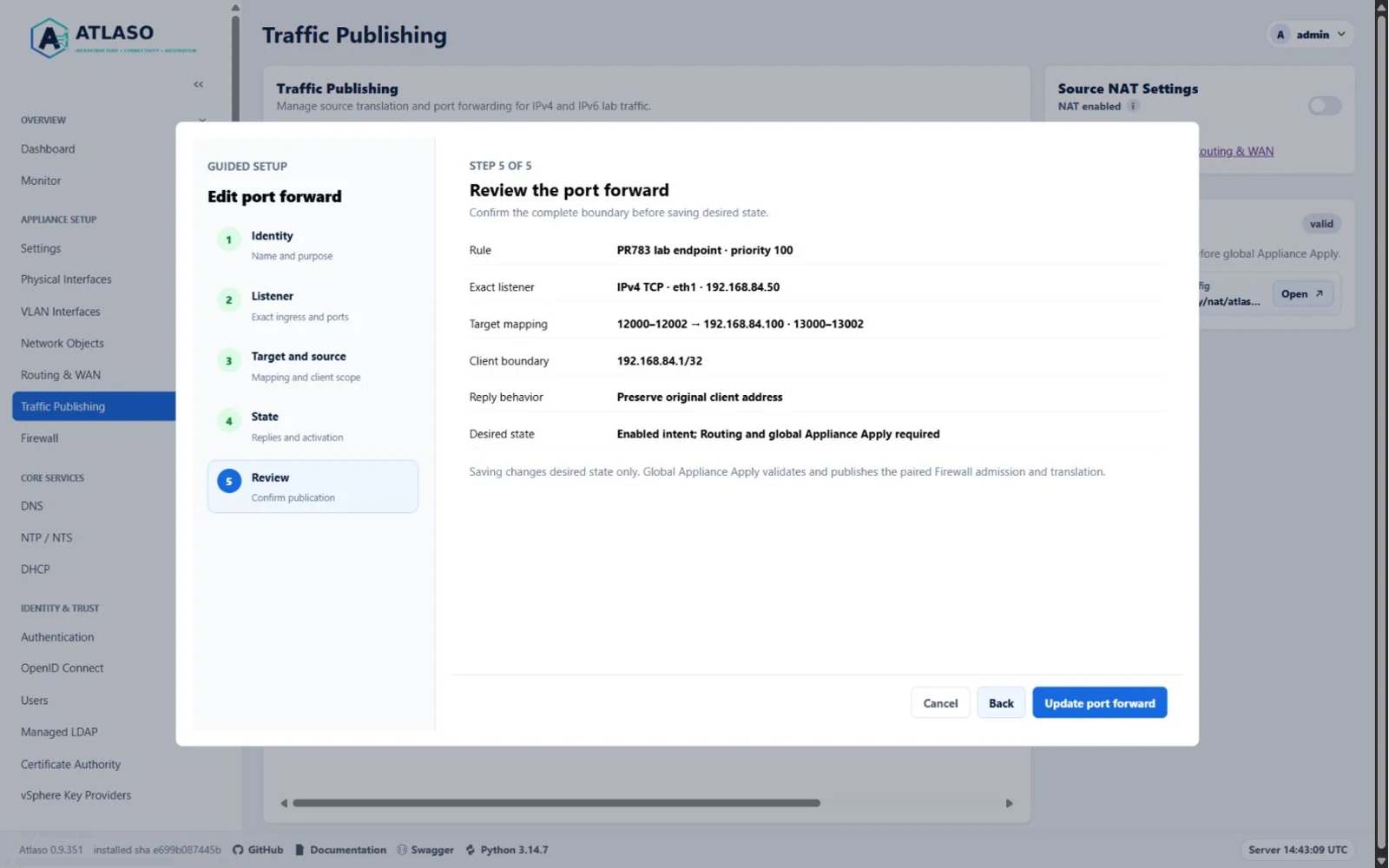
Figure: Review the listener, port mapping, client boundary, and replies before saving desired state.
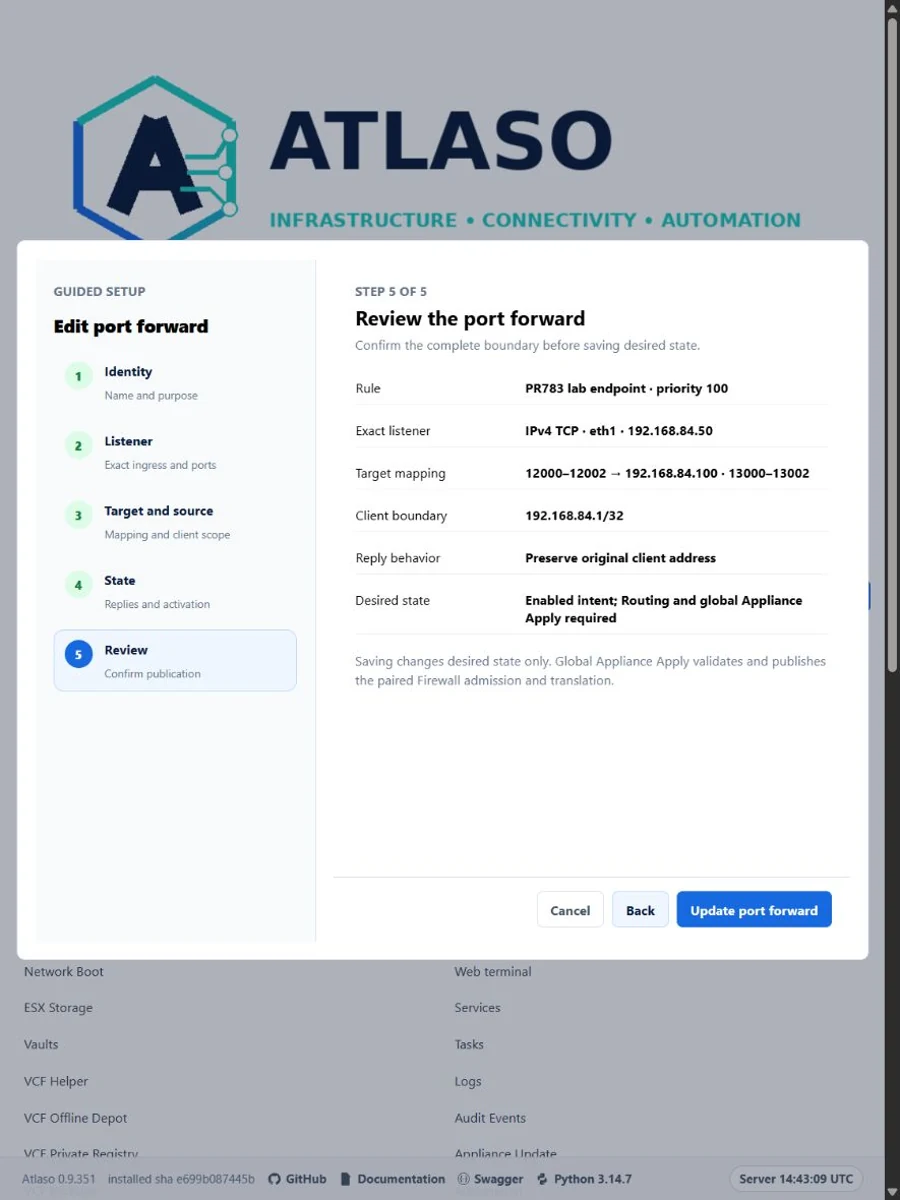
Figure: Review the listener, port mapping, client boundary, and replies before saving desired state.
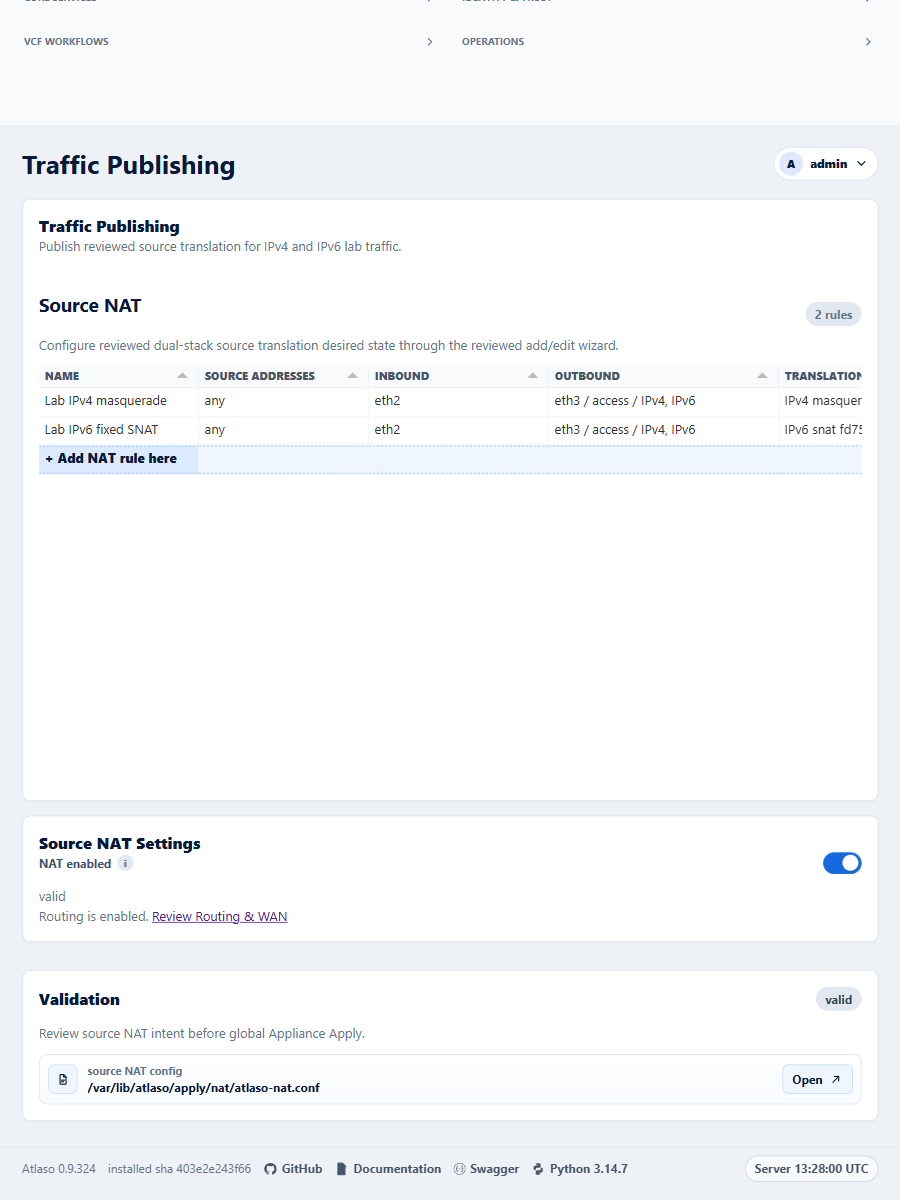
Figure: Traffic Publishing with reviewed IPv4 masquerade and the canonical NAT setting.
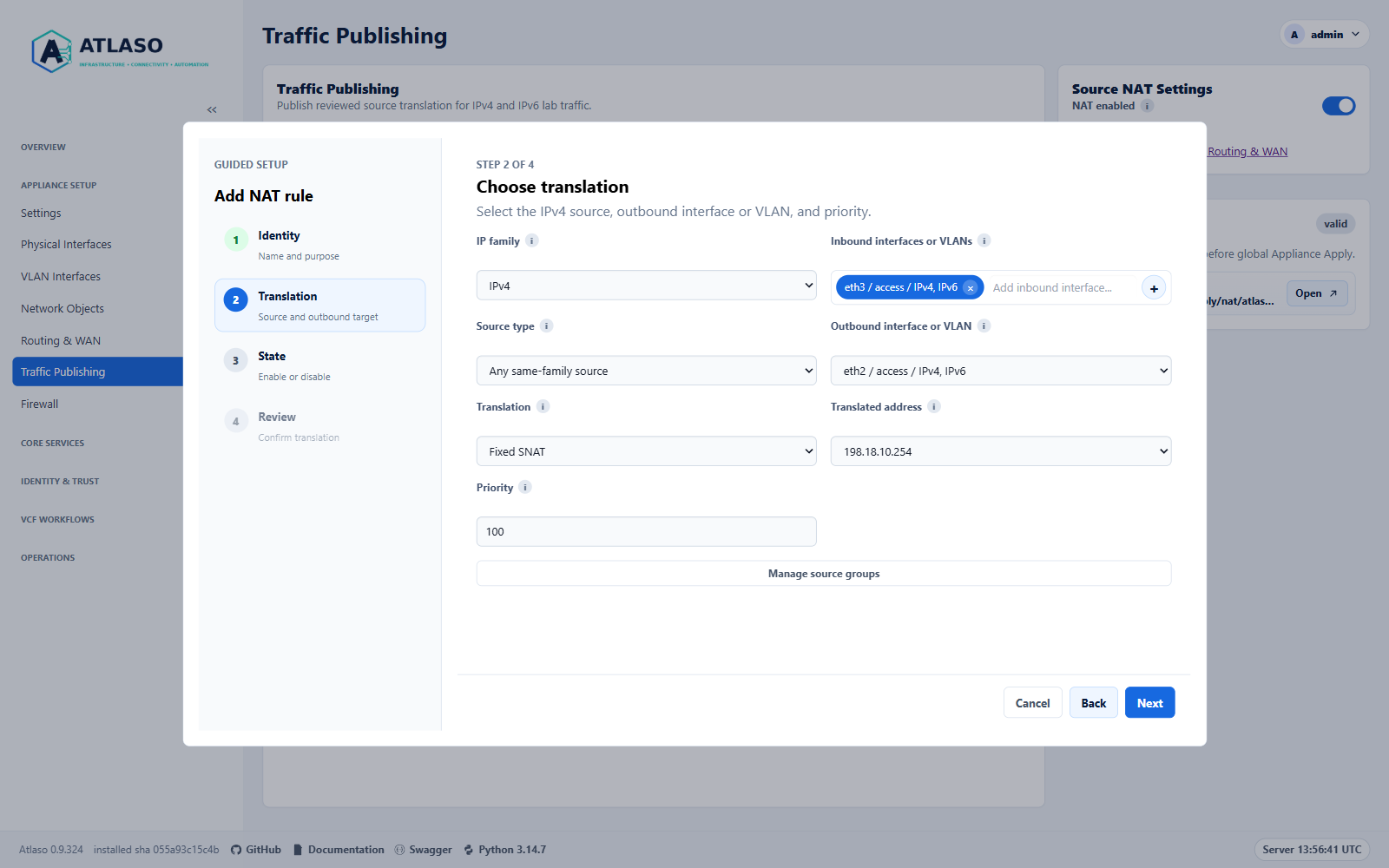
Figure: Choose an assigned translated address and open source groups in a separate tab without leaving the wizard.
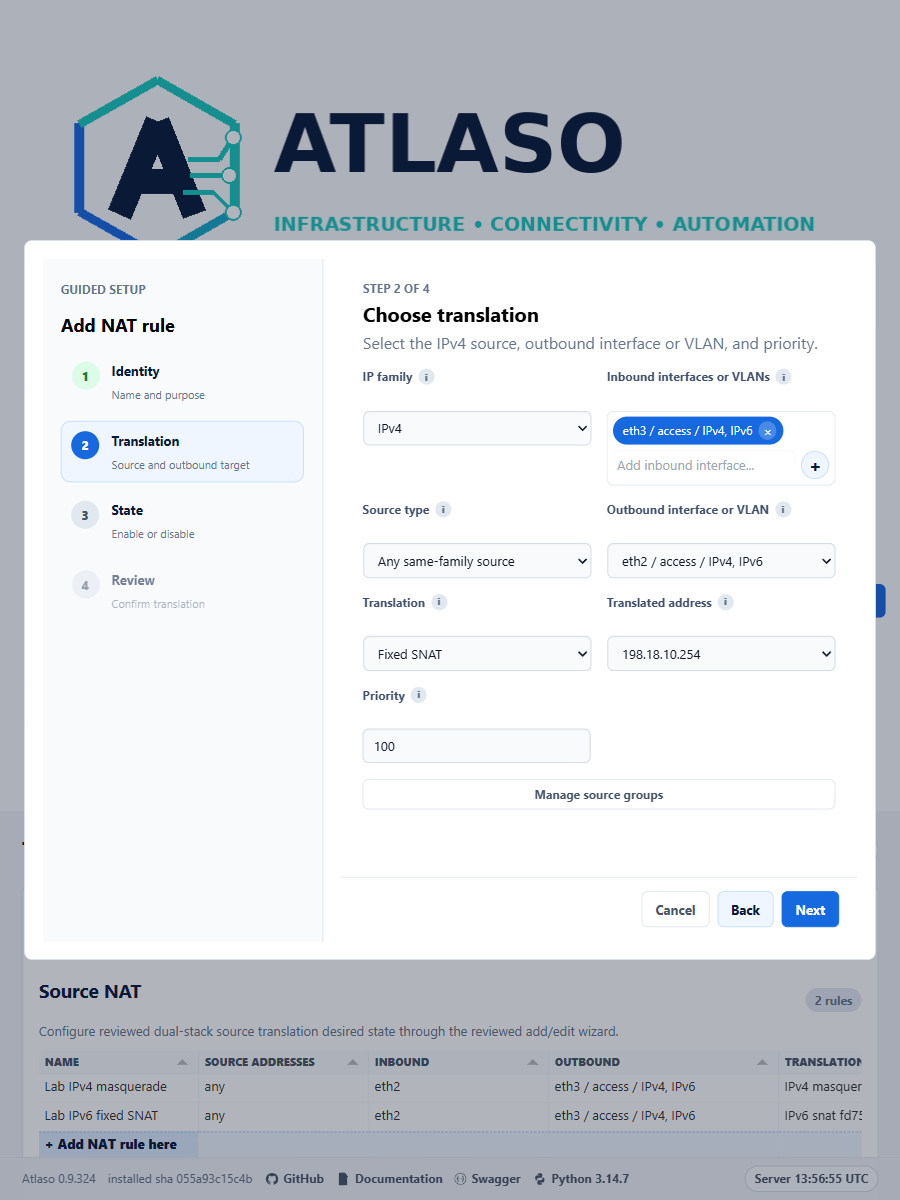
Figure: Choose an assigned translated address and open source groups in a separate tab without leaving the wizard.
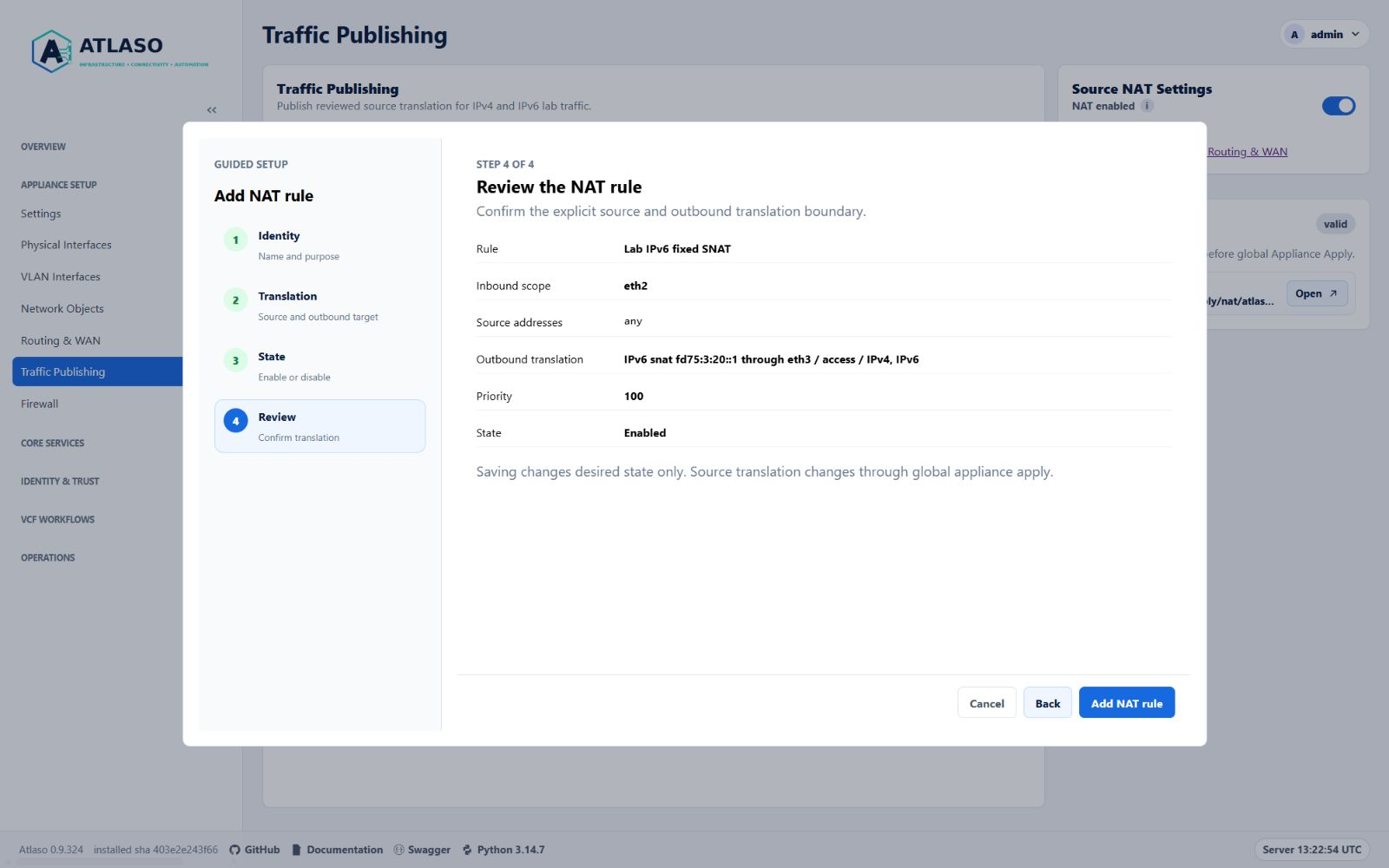
Figure: Review an IPv6 fixed-SNAT rule before saving desired state.
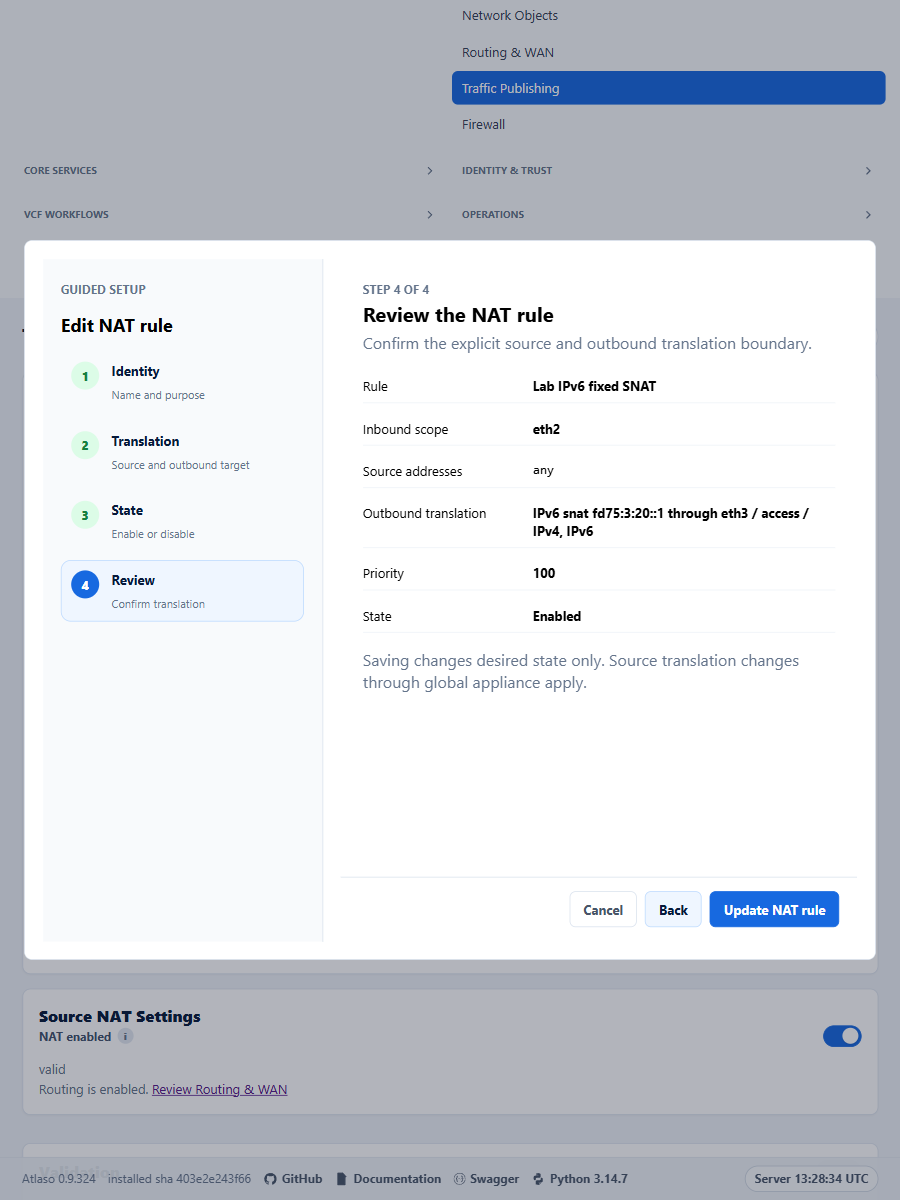
Figure: Review an IPv6 fixed-SNAT rule before saving desired state.